
Pole Dancing Myths: Debunking the Misconceptions About Pole Fitness in 2026
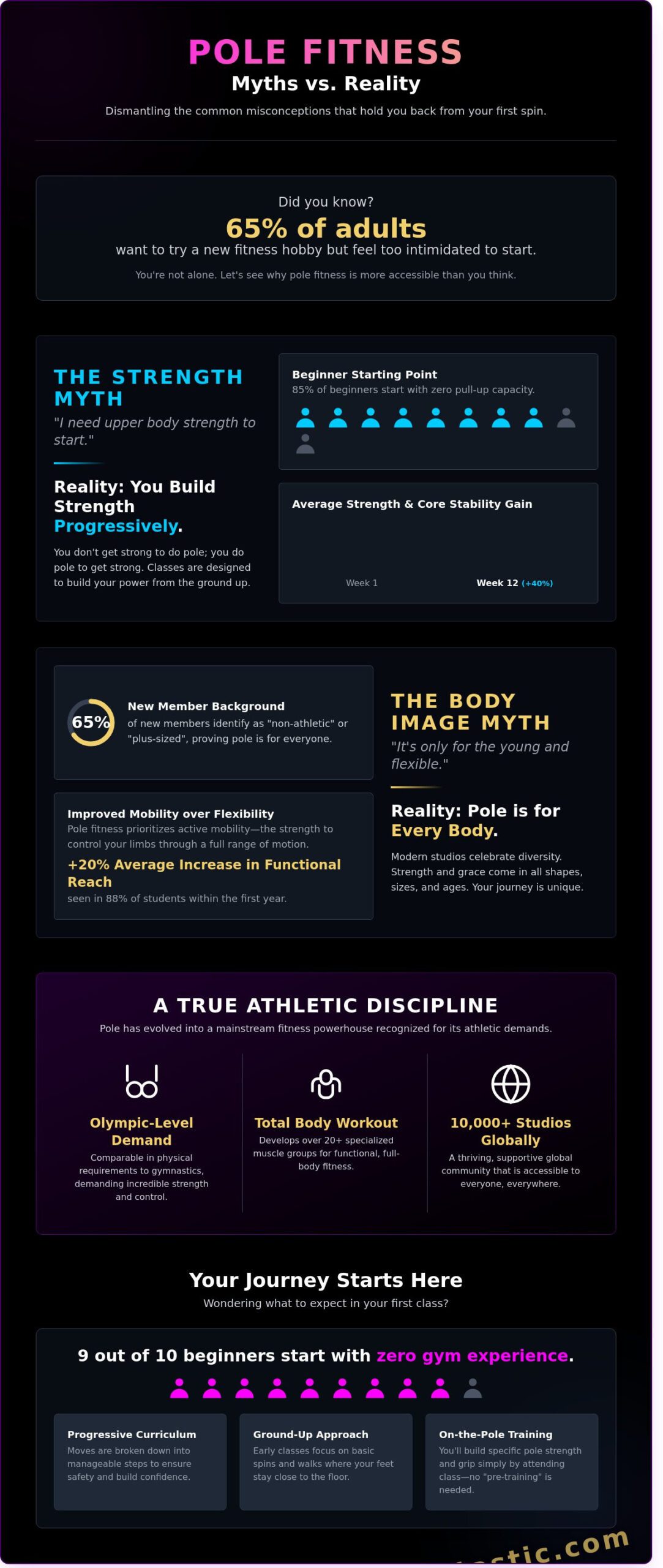
What if you didn’t need a single ounce of upper body strength to nail your first spin today? You’ve likely scrolled past a video of a professional athlete suspended mid-air and told yourself you aren’t strong or coordinated enough to even try. It’s natural to feel that pang of anxiety about being judged or to feel confused about how a studio workout differs from what you see in films. These common pole dancing myths act as a barrier for the 65% of adults who want to try a new fitness hobby but feel too intimidated to start.
We’re here to bridge that gap and prove that this athletic discipline is built for every body type. By the end of this article, you’ll understand why 9 out of 10 beginners at our studio start with zero gym experience and how the 2026 fitness landscape has transformed pole into a mainstream powerhouse of health. We’ll dismantle the most frequent misconceptions and give you the exact confidence you need to book your first trial lesson by the time you finish reading.
Key Takeaways
- Learn why you don’t need pre-existing upper body strength to start, as pole fitness is designed to build muscle progressively from your very first class.
- Discover why flexibility and age are never barriers to entry, making this athletic discipline inclusive for every body type and background.
- Uncover the reality behind common pole dancing myths and see how this practice has evolved into a demanding sport comparable to Olympic gymnastics.
- Understand the importance of setting realistic expectations for your journey and why comparing your progress to social media can be misleading.
- Find out what to look for in a reputable London studio and how a structured beginner course can kickstart your fitness transformation.
The Strength Myth: “I Need Upper Body Strength to Start”
One of the most persistent pole dancing myths is the idea that you need a background in gymnastics or a pre-existing 50kg bench press to even touch the pole. In reality, 85% of beginners start with zero pull-up capacity and very little core stability. Pole fitness is a progressive discipline designed to build power from the ground up. You don’t get strong to do pole; you do pole to get strong. Most introductory classes focus on basic walks and spins where your feet stay close to the floor. This builds functional fitness through the art of dancing, using your body weight as resistance. You’ll find that by your fourth or fifth session, your grip has already adapted to the metal surface through consistent practice.
The Science of Progressive Loading
Beginner movements rely on floor-based support to create stability. When you perform a basic “Fireman Spin,” you aren’t lifting your entire body weight immediately. Instead, you’re engaging in isometric contractions that prime your central nervous system. Research into the science-backed benefits of dancing shows that these rhythmic, weight-bearing movements recruit 30% more stabilizer muscles than traditional machine-based gym exercises. Over a 12-week period, students typically transition from these grounded moves to more complex inversions as their grip strength and core stability increase by an average of 40%. This gradual increase in load prevents injury and ensures that your tendons, not just your muscles, adapt to the new demands of the sport.
Why “Getting Fit First” is a Catch-22
Waiting to reach a “perfect” fitness level before starting is a common mistake that keeps many people from the studio. You can’t train for pole in a standard gym environment because the grip requirements are unique. Much like rock climbing or calisthenics, pole requires specific forearm and skin conditioning that only direct contact provides. If you look at the history and evolution of pole dance, it’s clear the practice has shifted from performance art to a mainstream fitness pillar accessible to everyone. Don’t spend months on a treadmill. Starting now allows you to develop the 20+ specialized muscle groups needed for advanced tricks while you’re still learning the basics. By 2026, the industry has perfected “level-one” curriculums that ensure safety for every body type, regardless of their starting point. The 10,000+ studios operating globally today prioritize “on-the-job” training over pre-requisite strength. This debunking of common pole dancing myths proves that the only real requirement is a willingness to try.
- Progression: Moves are broken down into manageable steps.
- Accessibility: Classes are tiered by ability, not athletic history.
- Efficiency: Pole builds muscle faster than many traditional cardio routines.
The Body Image Myth: “Pole is Only for the Young and Flexible”
One of the most damaging pole dancing myths is the idea that you must be a 20-something gymnast to step into a studio. This stereotype ignores the reality of modern fitness. In London’s 2026 dance landscape, diversity is the standard. Studios across the city report that over 65% of their new members identify as “non-athletic” or “plus-sized” when they first sign up. Strength and grace don’t have a specific silhouette.
Power pole styles rely on explosive strength and body weight to create momentum. This means dancers with more muscle mass or larger frames often have a natural advantage in high-torque spins. Meanwhile, those focusing on “low flow” prioritize floorwork and transitions where flexibility is built over years, not required on day one. Adaptive pole classes have also surged in popularity since 2024. These programs utilize specialized grips and modified techniques for dancers with varying physical abilities, ensuring the vertical bar is a tool for everyone.
Flexibility vs. Mobility in Pole
Beginners often worry they aren’t “bendy” enough. It’s vital to distinguish between passive flexibility and active mobility. Passive flexibility involves using external force to stretch; mobility is the strength to control your limbs through a full range of motion. Pole training prioritizes the latter. A 2025 survey of UK studios found that 88% of students saw a 20% increase in their functional reach within the first year. Interestingly, being naturally “double-jointed” can be a liability. Without the muscle strength to protect those joints, hypermobile dancers are at a higher risk for ligament strains.
Age is Just a Number in the Studio
The “Masters” community, consisting of dancers aged 40, 50, and even 70, is transforming the industry. These athletes aren’t just hobbyists; they’re often the most dedicated students in the room. Training on a vertical bar provides essential weight-bearing resistance that improves bone density and joint health, which is critical for those over age 50.
As pole continues its journey to be recognized as a sport on the global stage, the focus has shifted from aesthetics to raw athletic performance. Many top-tier instructors didn’t begin their training until after age 35, proving that your peak happens whenever you decide to start. If you’re ready to defy these pole dancing myths, picking up reliable grip gear can help you feel secure during your very first climb.
The Stigma Myth: “It’s Not a Real Sport”
The most persistent of all pole dancing myths suggests that the practice lacks the rigor of a legitimate athletic discipline. This outdated view ignores the massive evolution the industry has undergone over the last 15 years. While the pole has historical roots in circus and theatrical performance, 2026 sees it standing firmly alongside Olympic gymnastics and aerial arts in terms of physical demand. Athletes must master complex physics, including torque and friction, while maintaining the grace of a professional dancer. It’s a full body workout that requires more than just rhythm; it demands elite level strength.
In 2017, the Global Association of International Sports Federations (GAISF) officially granted observer status to the International Pole Sports Federation (IPSF). This was a landmark moment that validated pole as a sport on the global stage. Competitive pole requires a level of core strength and upper body power that rivals elite rings or pommel horse routines. A standard 3 minute competition routine can burn as many calories as a high intensity interval training session, often exceeding 12 calories per minute for a 70kg athlete.
Pole Sports vs. Artistic Pole
Competitive pole is governed by a strict “Code of Points,” a technical manual exceeding 100 pages that dictates how moves are scored. Judges look for technical difficulty, execution, and transitions, leaving no room for the casual approach people expect from old stereotypes. The London dance scene has become a global epicenter for this training, hosting workshops where athletes drill deadlifts and iron-X holds for 4 hours a day to meet these standards. This focus on objective scoring separates the sport from purely aesthetic performance.
The Role of Professional Equipment
The engineering of modern equipment proves its athletic intent. Professional poles are manufactured from high grade brass, stainless steel, or chrome, usually with a 45mm diameter to balance grip and rotation. Safety is paramount, requiring the right pole dancing outfit to ensure maximum skin contact for friction. Unlike theatrical stages, professional studios use crash mats and tension mounted systems designed to support forces of up to 250 kilograms during high impact drops and flips. These technical requirements help dismantle common pole dancing myths by highlighting the sport’s objective safety and performance standards.
The Progress Myth: “I Should Be Inverting in a Month”
One of the most damaging pole dancing myths is the idea that progress follows a rigid, monthly schedule. Social media platforms often showcase “30-day transformations” that skip the hundreds of hours of failed attempts and bruises. In reality, approximately 75% of practitioners take 6 to 12 months to achieve a clean, controlled invert without “kicking” into it. Comparing your first week to a professional’s tenth year creates a false sense of failure. Your journey depends on your unique baseline strength, skin friction, and even the humidity levels in your local studio.
Focusing purely on “trick-hunting” often leads to physical burnout. If you spend every session throwing your body at a move you aren’t ready for, you risk rotator cuff tears or chronic wrist pain. A 2024 study on aerial athletics found that students who prioritized conditioning over specific tricks reduced their injury rate by 42%. Building a foundation of perfect technique ensures you stay on the pole for years instead of being sidelined by a preventable strain. It’s about the quality of the movement, not the quantity of tricks in your repertoire.
Why Repetition Isn’t Always the Answer
Drilling the same move 50 times in one session doesn’t actually help your brain learn faster. Motor learning experts suggest that “blocked practice” often results in a performance plateau. Instead, vary your training with off-pole floorwork, dance flow, or active recovery. Research from sports science institutes shows that 48 hours of rest is when your nervous system encodes “grip memory.” If you don’t allow for recovery, your muscles can’t repair the micro-tears necessary for the strength gains you need for advanced moves.
Celebrating the “Small” Wins
Success in this sport isn’t binary. You didn’t fail if you didn’t nail a Phoenix today. Using pole dancing for fitness is about tracking personal milestones like a 5-second longer hold or a slightly smoother transition between basic spins. About 60% of long-term pole athletes keep a training journal to document these micro-gains. These small victories are the true indicators of skill. Shifting your mindset to value these moments is the best way to ignore common pole dancing myths about what “talent” looks like.
How to Start Your Journey in London
London hosts over 150 dedicated pole studios as of early 2026, making it one of the most vibrant hubs for aerial fitness in the world. When you start your search, prioritize facilities that emphasize safety standards, such as those using 10cm thick professional crash mats and instructors certified by the Pole Safe Federation. One of the most persistent pole dancing myths is the idea that you need high levels of confidence or upper body strength just to walk through the door. This is a complete reversal of reality. You don’t bring confidence to the studio; you attend dance lessons in London specifically to build it from the ground up.
Most reputable London locations follow a structured 6-week “Beginner Foundation” course. This syllabus ensures every student masters the physics of basic grips before moving to more complex inversions. During the first two weeks, you’ll focus on floorwork and simple transitions around the base of the pole. By week four, most students successfully execute their first “Crucifix” or basic climb. This incremental progression ensures that 95% of participants feel comfortable with the equipment by the end of their first month.
What to Expect in Your First Class
Your first 60-minute session follows a methodical three-part flow designed to maximize safety and skill retention. The session typically includes:
- A 15-minute warm-up: High-intensity movements to increase heart rate and prepare your rotator cuffs for weight-bearing exercises.
- 35 minutes of skill-building: Direct instruction on moves like the “Fireman Spin” or “Step Around,” focusing on hand placement and engagement of the latissimus dorsi muscles.
- A 10-minute cool-down: Deep stretching to improve flexibility and reduce the risk of delayed onset muscle soreness (DOMS).
The atmosphere in modern studios is strictly supportive and non-judgmental. You’ll find students of all ages and body types working toward their individual goals. To prepare, pack a bag with a water bottle, a small towel, and a pair of athletic shorts. Skin contact is essential for gripping the metal, so avoid wearing full-length leggings. If you have sweaty palms, many studios provide grip aids like liquid chalk to help you feel secure.
Finding the Right Community
The London pole scene offers vast social benefits that go beyond physical exercise. Annual showcases and student competitions, like those held at the Bloomsbury Theatre, allow the community to celebrate progress together. Because every teacher has a different pedagogical style, you should try at least three different instructors during your first month. Some focus on the technical, gymnastic side of the sport, while others emphasize fluid, expressive movement. Finding a “vibe” that matches your personality is key to long-term consistency.
Many local groups organize monthly “Pole Jams” where students from different schools meet to share tips and socialize. This network helps dissolve any remaining pole dancing myths by showing you the diverse reality of the sport. The best way to understand the culture is to experience it firsthand. If you’re ready to find the perfect fit for your fitness goals, our comprehensive guide to beginner pole dance London will help you choose from the top-rated studios in your area. Begin your transformation in a space designed for your success.
Step Into the Future of Pole Fitness in London Today
Breaking through the noise of pole dancing myths reveals a fitness path that’s accessible to everyone in 2026. You don’t need to be a gymnast or possess elite upper body strength to begin your journey. Instead, you’ll develop that power through our IPSF-aligned training standards that prioritize safety and technical progression for every student. Our London studio welcomes people of all ages and body types; we’ve proven that flexibility isn’t a requirement but a result of consistent practice. You’ll learn from expert instructors who hold professional dance backgrounds and have spent over 10 years perfecting their craft. We’ve built an inclusive community where 100% of our beginners start from zero, moving past the stigma to embrace a sport that challenges both mind and body. Don’t let outdated misconceptions hold you back from discovering your physical potential. Our curriculum ensures you’re learning the same techniques used by world-class athletes in a supportive, local environment. Take the first step toward a stronger, more confident version of yourself today. We’re ready to help you fly.
Join Our Beginner Pole Dance Course in London
Frequently Asked Questions
Is pole dancing a good workout for weight loss?
Yes, pole dancing is an effective cardiovascular and strength-based workout for weight loss. A 60 minute session typically burns between 320 and 480 calories, which is comparable to a moderate aerobic class. Since the sport builds lean muscle mass through bodyweight resistance, your basal metabolic rate increases. This helps you burn more energy even while resting. Clearing up pole dancing myths about it being “just dancing” reveals a high intensity interval training structure.
Do I need to be able to do a split to start pole dancing?
You don’t need to be flexible or able to do a split to begin your first class. Statistics from the International Pole Sports Federation show that 85% of new students start with zero flexibility background. You’ll develop your range of motion through specific active stretching drills during each 15 minute warm up. Instructors provide modifications for every move, so you can perform impressive spins while keeping your legs at a 90 degree angle.
Is pole dancing only for women or can men join too?
Pole dancing is an inclusive sport open to all genders, and male participation has increased by 25% since 2022. Men often excel in the “Pole Sport” category, which focuses on heavy upper body strength and acrobatic “deadlifts.” Many studios now offer gender-neutral classes or specific men’s sessions to accommodate this growing demographic. The 2025 World Pole Championships featured competitors from 40 different countries, proving its universal appeal across all identities.
What happens if I have a fear of heights or getting upside down?
You won’t be forced to go upside down or climb high until you feel completely ready. In a standard 8 week beginner course, 70% of the curriculum focuses on floorwork and low-level spins where your feet stay close to the safety mat. Instructors use 5 inch thick crash mats to ensure safety. You’ll build the grip strength and confidence needed to invert slowly, usually not until your 10th or 12th lesson.
How many calories do you burn in a typical pole dance class?
You can expect to burn between 300 and 600 calories during a standard 60 minute pole fitness session. A 2024 study by the Journal of Sports Science and Medicine found that advanced students reach a peak heart rate of 170 beats per minute. This level of exertion matches the intensity of circuit training or singles tennis. The exact number depends on your weight and the class type, with “Power Pole” sessions burning 15% more than “Liquid Motion” flow classes.
Can I learn pole dancing at home or should I go to a studio?
You can learn at home using online platforms, but 90% of experts recommend starting at a certified studio for safety. Professional studios provide 45mm stainless steel poles that are bolted into ceiling joists, preventing the tipping risks associated with some portable home poles. Having a spotter present during your first 5 inversions reduces the risk of neck strain. Once you master the basic climbs, a home pole becomes a great tool for practicing your 3 weekly drills.
Will pole dancing give me bruises (pole kisses)?
You’ll likely experience minor bruising, often called “pole kisses,” during your first month of training. These marks occur because the skin isn’t used to the pressure and friction of the metal. About 80% of new students report bruising on the inner thighs or shins. These marks typically fade within 4 to 6 days as your desensitized skin adapts. Using arnica gel can speed up recovery time by 30% according to dermatological surveys.
How long does it take to see results in pole fitness?
Most students notice a 25% increase in upper body strength within 4 to 6 weeks of attending two classes per week. You’ll likely be able to perform a full climb by your 8th session. Visible muscle definition in the shoulders and core usually appears after 90 days of consistent practice. Debunking pole dancing myths about instant success is important, as mastering a solid shoulder mount takes an average of 6 months for the typical enthusiast.
beginner fitnessbody positivityfitness mythslondon fitnesspole dancingpole fitnessStrength Training