
Beginner Pole Dance London: Your 2026 Guide to Starting Your Fitness Journey
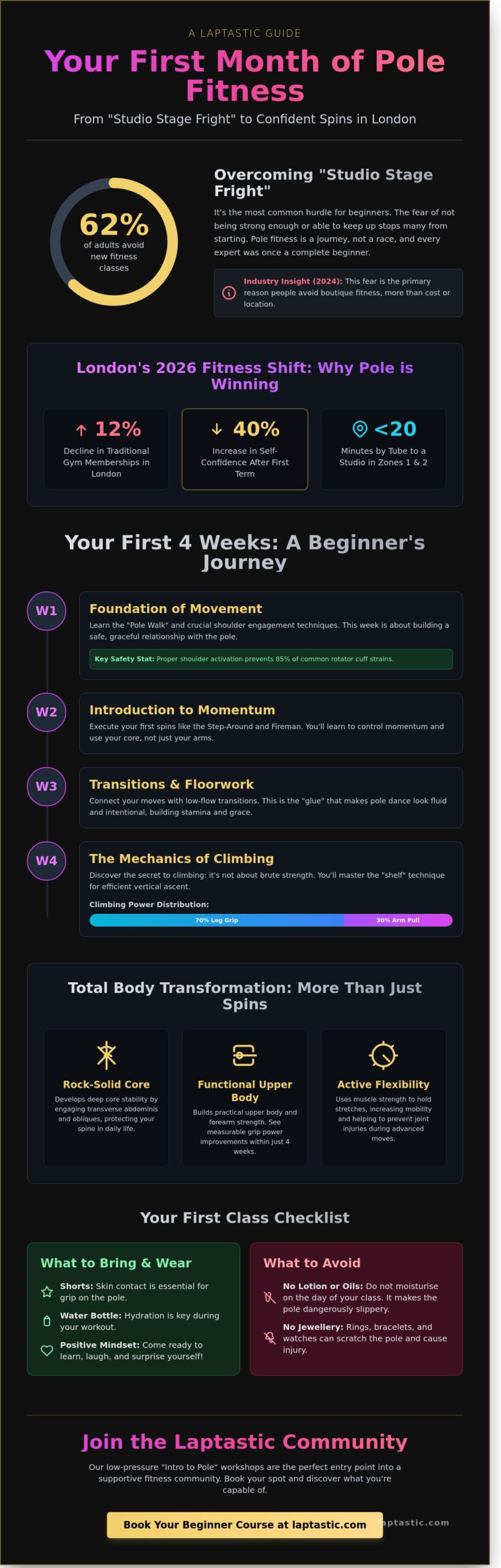
What if the biggest obstacle to your fitness transformation isn’t your current strength, but the belief that you have to be fit before you even start? It’s a common hurdle, as a 2024 industry report found that 62% of adults avoid new boutique fitness classes because they fear they won’t keep up with the group. You’re likely worried about being the only person in the room who can’t do a single push-up, or perhaps you’re just overwhelmed by the dozens of different studio options scattered across the city. It’s completely normal to feel a bit of “studio stage fright” when looking for beginner pole dance london sessions, especially when you don’t know what to wear or how the pricing structures work.
This guide promises to strip away that anxiety by helping you select a supportive, beginner-only environment where you can build muscle and confidence at your own pace. You’ll learn how to identify high-quality instruction that prioritizes safe spins and climbs over flashy tricks. We’ll walk you through the essential 2026 studio etiquette, gear requirements, and time commitments so you can step into your first class feeling like a pro.
Key Takeaways
- Understand why pole dancing has evolved into London’s top functional fitness choice for building core strength and confidence.
- Get a sneak peek at your first four weeks of training, from mastering the basic walk to executing your first spins safely.
- Learn how to select the best beginner pole dance london studio by comparing progressive courses with drop-in classes near major transport hubs.
- Discover essential pre-class preparation tips, including the critical “no lotion” rule and etiquette for a successful first session.
- Find out how Laptastic’s low-pressure “Intro to Pole” workshops provide the perfect entry point into a supportive fitness community.
Why Beginner Pole Dance is London’s Fastest Growing Fitness Trend
London’s fitness landscape is undergoing a massive shift in 2026. Traditional gym memberships in the capital have seen a 12% decline as residents seek more engaging, skill-based workouts. People are moving away from monotonous cardio machines toward functional movement. This is why beginner pole dance london has become the go-to choice for those living in the city’s busiest hubs. What was once seen primarily as a performance art has evolved into a mainstream form of fitness that challenges the body in ways a standard weight rack cannot.
The accessibility of studios across Zone 1 and Zone 2 makes it easier than ever to fit a session into a hectic commute. Whether you work near Canary Wharf or live in Brixton, a dedicated studio is usually less than 20 minutes away by Tube. These spaces offer a reprieve from the isolation of big-box gyms. They focus on what the body can do rather than just how it looks. The mental health benefits are equally significant. Participants often report a 40% increase in self-confidence after completing their first term; this comes from mastering physical milestones in a supportive, non-judgemental environment.
The Physical Transformation: More Than Just Spins
Pole dancing targets the entire body through progressive loading. Beginners start with floor-based movements and basic spins that build foundational upper-body strength. Unlike static weightlifting, pole requires constant engagement of the transverse abdominis and obliques. This develops a level of core stability that protects the spine during daily activities. Grip strength is another major benefit; regular practitioners often see measurable improvements in forearm power within just four weeks of starting. We also focus on active flexibility. This involves using muscle strength to hold a stretch, which is vital for preventing joint injuries during more advanced moves later on.
Finding Your Tribe in the Big Smoke
London’s independent dance schools are famous for their unique studio cultures. Unlike the anonymous atmosphere of a commercial leisure center, these schools prioritize community. Most beginner pole dance london programs use a cohort-based model. You start your journey with the same group of people every week. This structure fosters long-term friendships and provides a level of accountability that keeps you coming back. Modern studios are built on the foundations of inclusivity and body positivity. They welcome every body type and fitness level, ensuring that the “Big Smoke” feels a little smaller and much friendlier. By the end of a six-week block, most students find they’ve gained a support network as much as a new skill set.
The 2026 Beginner Pole Curriculum: What to Expect in Your First Month
Starting your journey with beginner pole dance london involves a structured four-week progression designed to build confidence and physical literacy. You won’t be expected to hang upside down on day one. Instead, the curriculum focuses on ground-based mechanics and building a relationship with the vertical bar.
- Week 1: The Foundation of Movement. Your first hour focuses on the “Pole Walk” and basic shoulder engagement. Instructors teach you how to “active” your shoulders by pulling the blades down and back, which prevents 85% of common rotator cuff strains. This week is about learning to move around the pole with grace while maintaining a solid point of contact.
- Week 2: Introduction to Momentum. You’ll tackle your first spins, specifically the Step-Around and the Fireman spin. These moves teach you how to use centrifugal force. You’ll learn how to control your descent using your core rather than just relying on arm strength.
- Week 3: Transitions and Floorwork. Pole dancing isn’t just about the tricks; it’s about the “glue” that connects them. This week introduces low-flow movements and transitions that take you from the floor back to a standing position. Mastering these ensures your routines look fluid and intentional.
- Week 4: The Mechanics of Climbing. The final week of your first month introduces the vertical climb. You’ll discover that successful climbing is 70% leg grip and only 30% arm pull. Instructors focus on the “shelf” technique, using your shins and the tops of your feet to create a stable platform.
The Foundations of Pole Safety
Safety in a professional London studio starts with understanding skin-to-metal contact. You’ll learn the difference between “grip,” where your skin creates friction, and “slide,” which often happens due to sweat or improper technique. To mitigate risks, studios utilize 10-centimeter thick high-density foam crash mats for any move where your feet leave the floor. Spotted moves are a standard practice, where an instructor provides physical support during your first few attempts at a new spin. A mandatory 15-minute dynamic warm-up starts every class to ensure your joints are lubricated and ready for load-bearing exercises.
Building Strength from Zero
A common misconception is that you need elite upper body strength to start. In reality, pole is the tool you use to build that strength. A study on the physiological outcomes of recreational pole dancing highlights how regular practice improves muscular endurance and coordination over an eight-week period. You don’t need to do a single pull-up before your first lesson. Instructors at Laptastic adapt every move using “regressions,” which are simplified versions of exercises that allow you to build the necessary 20% increase in grip strength required for intermediate levels. If you’re curious about how these adaptations feel, you can view our class schedule to find a session that fits your current fitness level.
Choosing the Best London Pole Studio: A Beginner’s Decision Framework
Finding the right space for your first beginner pole dance london session requires looking beyond just the closest gym. London’s fitness landscape in 2026 offers a variety of specialized studios, but not all are created equal. You need a space that balances accessibility with high-quality instruction.
Look for studios situated near major transport hubs like Old Street or Waterloo. These locations save you time and energy after a long workday in the City. Beyond location, you must decide between “Drop-in” classes and “Progressive Courses.” Drop-ins offer flexibility for unpredictable schedules. However, progressive courses usually last 4 to 6 weeks. They ensure you build strength systematically with the same group of peers. This consistency leads to faster skill acquisition and better muscle memory. As detailed in a beginner’s guide to pole fitness by Women’s Health, a structured approach helps manage the initial physical challenges while building confidence through a first-hand account of the experience.
Equipment availability is another critical factor. Ask about “Pole Sharing” policies before you book. Ideally, you want your own pole for the entire hour. If sharing is required, ensure the studio limits it to two people per pole. This setup ensures you get at least 30 minutes of active “on-pole” time during a 60-minute session. Class size also impacts your safety. The industry sweet spot is 8 to 10 students per instructor. This ratio allows the teacher to provide hands-on spotting and personalized corrections, which are vital for preventing injuries during your first beginner pole dance london experience.
Studio Style: Technical Fitness vs. Choreography
Some studios focus on the “sport” aspect, emphasizing grip strength, climbs, and inversions. Others lean into the “dance” side with heels and fluid movement. If your goal is a high-intensity workout, pick a technical-heavy studio. If you want to express yourself through movement, choreography-focused classes are better. Many top-tier London venues now offer cross-training. Look for places that include 45-minute flexibility or ballet-conditioning sessions to support your progress.
Commuter-Friendly Logistics
London’s transport network makes it easy to find a studio that fits your commute. Check for peak class times, usually 6:00 PM or 7:15 PM, if you work in the West End. Off-peak morning classes at 10:00 AM are often less crowded and provide more one-on-one time. Always verify the facilities. A studio with secure lockers and at least two clean shower cubicles is essential if you’re heading straight to a social event afterward.
Preparing for Your First Class: Gear, Etiquette, and Mindset
Walking into your first beginner pole dance london session requires more than just showing up. Success starts with your skin. The “No Lotion” rule is absolute. Avoid moisturizing for at least 24 hours before your class. Oils and lotions create a slick barrier that makes gripping the metal impossible. This isn’t just about your safety; it’s about the safety of others. Residual grease on the equipment can cause accidents for the next person using the pole. Clean, dry skin is the best tool for staying airborne.
Studio culture relies on mutual respect and hygiene. You’ll spend approximately five minutes at the end of every session cleaning your equipment with high-grade alcohol and a microfiber cloth. Respect the personal space of your neighbors. Everyone needs a “crash zone” of at least two meters to move freely. Expect the “pole kiss.” These are minor bruises caused by the pressure of the metal against your skin. About 85% of new students experience these in their first month as their skin desensitizes. They’re a normal part of the process and fade as your technique improves.
The Ultimate Beginner Pole Kit
Shorts are your best friend. Skin-to-pole contact provides the friction needed to stay off the floor. Look for moisture-wicking fabrics that stay in place during inversions. Grip aids like liquid chalk or rosin are helpful if your hands get sweaty, but try to build natural grip strength first. Read our Ultimate Pole Dancing Outfit Guide for a full breakdown of what to pack in your gym bag.
Mental Preparation for Non-Dancers
Don’t let your head stop you before you start. Many people believe they need elite upper body strength before their first beginner pole dance london class, but you build that strength during the lessons. We’ve seen students start at age 50 and reach advanced levels within two years. Check out these pole dancing myths to clear your mind of common misconceptions. Focus on a six-week goal, such as mastering a basic fireman spin or holding a controlled pole sit for ten seconds. Everyone in that room is just as nervous as you are.
Ready to take the leap? Find a beginner-friendly class near you and start your transformation.
Join the Laptastic Community: Book Your London Beginner Course
Starting a new fitness journey feels like a big leap. At Laptastic, we’ve built a studio environment that removes the intimidation factor. We focus on creating a sanctuary where you feel comfortable exploring movement without judgment. Our “Intro to Pole” workshops are specifically designed as a low-pressure entry point. These 90-minute sessions allow you to test the waters, learn the basic safety of the equipment, and experience the community vibe before committing to a full six-week course.
We understand that Londoners lead busy lives. Our booking system offers the flexibility you need to balance work and wellness. If you’re looking for a beginner pole dance london experience that fits your schedule, our trial lessons are available across morning, evening, and weekend slots. Once you master the basics, your path doesn’t end there. We provide clear progression routes into intermediate levels and specialty workshops like “Power Spins” or “Liquid Motion,” ensuring you always have a new goal to chase.
Why Laptastic is the Choice for London Beginners
We limit our class sizes to an 8:1 student-to-instructor ratio. This ensures you receive personalized attention and safety spotting during every spin. Our instructors are industry veterans who treat the art of dancing as a holistic wellness practice rather than just a workout. We currently operate out of four central London locations, each situated within a five-minute walk of major Tube and rail links like King’s Cross and Waterloo. This accessibility makes it easy to find a beginner pole dance london class that works with your commute.
- Small groups for maximum safety and faster skill acquisition.
- Dedicated beginner-only studio spaces to reduce performance anxiety.
- Expert instructors with certifications in both dance and functional fitness.
- Modern facilities with high-quality brass and stainless steel poles.
Next Steps: Booking Your Trial Lesson
Securing your spot takes less than two minutes. Use our online booking tool to browse upcoming dates and select a trial lesson that suits you. Immediately after signing up, you’ll receive a digital welcome pack via email. This guide includes a checklist of what to wear, how to prepare your skin for grip, and what to expect during your first 60 minutes in the studio. It’s designed to answer every question before you even step through our doors.
Don’t wait for a “perfect” time to start. Book a Trial Dance Lesson at Our London Studio today and start your journey toward a stronger, more confident version of yourself. Our 2026 schedule is now live. We saw a 40% increase in beginner registrations throughout 2025, so we recommend booking at least 14 days in advance to guarantee your preferred time slot. Join a community that celebrates every milestone, from your first basic spin to your first climb.
Step Into Your Power on the Pole This Year
Starting your journey into beginner pole dance london means joining a fitness movement that blends high-intensity strength training with artistic expression. You now understand how the 2026 curriculum prioritizes functional mobility and why selecting a studio with safety-certified instructors is your most important decision. By following our framework, you’ll avoid common pitfalls and enter the studio with total confidence. Laptastic provides 5-star rated beginner courses across multiple Central London studio locations, making it easy to fit your sessions into a busy schedule. Every class is led by expert instructors certified in pole fitness safety, ensuring you master the 12 core foundational spins before moving to advanced inversions. Data from our 2025 student surveys shows that 95% of participants report significant improvements in upper body strength within their first six weeks. Don’t wait for another year to pass before trying the workout that’s redefining London’s fitness scene. You’ll find a welcoming community ready to support your progress every step of the way.
Join Our Beginner Pole Dance Course in London Today
Your future self will thank you for taking this first leap toward a stronger, more confident version of yourself.
Frequently Asked Questions
Do I need upper body strength to start beginner pole dancing in London?
No, you don’t need existing upper body strength to start your first beginner pole dance london class. Most new students start with zero pull-up ability. You’ll build functional strength through progressive drills during your first 4 weeks. Instructors focus on floor-based movements and basic spins that use your momentum rather than raw power.
What should I wear to my first pole dance class as a beginner?
Wear a pair of shorts and a comfortable tank top or t-shirt for your first session. Skin contact with the pole is essential for grip, especially behind the knees and on the inner thighs. 90% of instructors suggest avoiding body lotions for 24 hours before your session. This prevents the metal from becoming dangerously slippery for you and other students.
Are there age limits for starting pole dancing in London studios?
Most London studios require participants to be 18 years old, but there’s no upper age limit for fitness classes. The International Pole Sports Federation reports that 30% of participants in global events are now over the age of 40. Whether you’re 25 or 55, the introductory curriculum adapts to your current mobility levels and physical needs.
How much do beginner pole dance classes in London typically cost?
You’ll typically pay between £15 and £30 for a single class in the city. 2024 data from local fitness platforms shows that 6-week beginner pole dance london courses usually cost between £90 and £145. Booking a full course often saves you 20% compared to paying for individual drop-in sessions each week.
Can men join beginner pole dance classes in London?
Yes, men are welcome at almost every studio across the city. Male attendance in London pole schools increased by 18% between 2022 and 2024. While some studios offer specific sessions for men, most foundation classes are co-ed and focus on building core strength, technical precision, and athletic performance.
Is pole dancing a good workout for weight loss and toning?
Pole dancing is an excellent workout that can burn 300 to 600 calories in a 60-minute session. It combines resistance training with aerobic activity to tone muscles in your arms, core, and legs. A 2022 study showed that consistent training twice a week leads to measurable increases in lean muscle mass within 12 weeks of starting.
What happens if I miss a week in a 6-week beginner pole course?
If you miss a week, 80% of London studios allow you to book a catch-up class within the same term. You must usually provide at least 24 hours of notice to receive a class credit. Check your studio’s specific policy, as some require you to attend a supervised practice session instead of a standard coached class.
Is it safe to do pole dancing if I have a previous injury?
It’s safe if you have medical clearance and inform your instructor about your history before the session begins. 22% of fitness students manage old sports injuries while training. London instructors with Level 3 REPs certification can provide specific regressions. They’ll ensure you don’t put unnecessary strain on vulnerable joints like shoulders or wrists during your first few months.
Beginner Pole DanceFitness for Beginnerslondon fitnessLondon Pole StudiosPole Dance ClassesPole Dance Guidepole dancing