
The Art of Pole Dancing: Busting 5 Common Myths About Fitness and Adult Entertainment
In October 2017, the Global Association of International Sports Federations officially recognized pole sports as a professional discipline, yet many people still struggle to separate this gravity-defying athleticism from the historical shadows of adult entertainment. You’ve likely felt a sharp pang of hesitation when considering a trial class, worrying that friends or coworkers might mistake a grueling core workout for a scandalous career choice. It’s a heavy social weight to carry, especially when you’re already anxious about whether you have enough upper body strength to even hold onto the brass.
We know how intimidating it feels to step into a studio when you don’t feel fit enough or fear being judged by your peers. You deserve to know the truth about how this practice evolved from misunderstood stigmas into a world-class fitness discipline that builds elite strength and mental resilience. This guide dismantles five persistent myths that confuse performance art with the sex industry, giving you the clarity needed to reclaim your fitness journey on your own terms.
Key Takeaways
- Understand how pole dancing evolved from its historical origins into a modern discipline of vertical gymnastics and performance art.
- Learn the biomechanics behind the “effortless” look, including the elite grip strength and physical conditioning required for professional-level mastery.
- Challenge common misconceptions by exploring how the sport has moved beyond adult entertainment stigmas to become a global fitness phenomenon with Olympic aspirations.
- Discover the critical safety features and instructor credentials you must verify when choosing a reputable pole dance studio in London.
- Gain insights into why starting with a structured “Foundation” class is essential for building the strength and technique needed for advanced artistry.
Defining the Art of Pole Dancing vs. Adult Entertainment Stigmas
Modern pole dancing has transcended its mid-20th-century associations to become a rigorous form of vertical gymnastics and performance art. While many people still associate the pole with neon lights, the 21st-century reality is far more diverse. Today, it’s a multidisciplinary practice that combines dance, acrobatics, and strength training. The History of pole dancing reveals a complex lineage, tracing back to 1920s traveling fairs where dancers used tent poles for support during “hoochie coochie” performances. This era eventually led to the nightclub scene of the 1970s and 80s, which cemented the link between the pole and the adult entertainment industry in the public’s mind.
The narrative began to shift significantly around 2003. Fitness enthusiasts started recognizing the immense physical toll and skill required to perform these movements. By 2005, the “art of pole dancing” emerged as a global fitness movement, moving out of clubs and into dedicated studios. Labeling these modern training spaces as adult entertainment is increasingly inaccurate. Most 2024 studios function similarly to yoga or CrossFit boxes, focusing on progressive skill acquisition, muscle conditioning, and community building rather than erotic performance.
The Evolution of Vertical Dance
The practice didn’t start in a vacuum. It draws heavily from Chinese Pole, a circus tradition dating back to the 12th century, and Mallakhamb, an Indian sport from 1135 AD involving wooden poles. In 2009, the International Pole Sports Federation (IPSF) was formed to standardize the sport for potential Olympic recognition. London became a central hub for this growth when the first dedicated fitness studios opened in 2003, sparking a European movement that prioritized athletic excellence. These organizations have successfully codified moves, ensuring safety and competitive integrity across 30 different countries.
Separating Performance from Industry
Clarity in terminology is essential for understanding the modern landscape. Professionals now distinguish between “Pole Sport,” which focuses on technical difficulty and strength, and “Pole Art,” which emphasizes storytelling and choreography. While “Exotic Dance” remains a popular sub-genre that embraces the movement’s sensual history, it’s often practiced as a form of personal empowerment rather than for a commercial audience. The art of pole dancing is a discipline requiring elite-level strength and flexibility. By using specific terms, practitioners can honor the history of the movement while distancing the fitness movement from the sex industry. This distinction helps 90% of studio owners create inclusive environments where the focus remains on the athlete’s physical journey and artistic expression.
The Physicality and Skill Behind the Art of Pole Dancing
The seamless glide of a dancer around a vertical bar often masks the intense physical toll required to stay airborne. Achieving that “weightless” aesthetic isn’t about magic; it’s about mastering skin friction and extreme grip strength. To maintain a hold, dancers rely on specific contact points like the back of the knees, the inner thighs, and the waist. This creates significant friction, leading to what the community calls “pole kisses,” or minor bruises that signal a body adapting to new pressures. It’s a discipline that demands the same level of technical precision as Olympic-level athletics.
The biomechanics involved are complex. Unlike traditional weightlifting, pole dancing requires the body to move through multiple planes of motion while supporting its entire weight against gravity. This is why sports scientists frequently compare the sport to professional gymnastics. A 2022 study published in the International Journal of Sports Science and Physical Education explored the physical and psychological benefits of this activity, noting how it improves muscular endurance and body image. While the roots of the movement are often linked to adult entertainment, the modern evolution focuses heavily on the athletic prowess and creative agency of the performer.
A Full-Body Workout Like No Other
Every class serves as a hidden gym-level workout that targets the latissimus dorsi and obliques with more intensity than standard crunches or pull-ups. You’ll engage stabilizing muscles that rarely see action in daily life. Beyond raw power, the choreographed routines provide a high-intensity cardiovascular challenge. Research into the science-backed benefits of dancing suggests that by 2026, more people will turn to these rhythmic movements to improve heart health and coordination. If you’re ready to test your limits, you can find local training sessions that cater to all fitness levels.
The Artistic Component: Expression and Flow
The transition from a “trick” to a “dance” happens through flow. This is the ability to move between high-intensity inversions and floorwork without visible pauses. Professional pole artistry isn’t just about strength; it’s a narrative medium. Dancers use musicality to tell stories, using the pole as a partner rather than just a prop. This creative expression is a primary driver for the mental health benefits associated with the sport. It allows participants to build body confidence by focusing on what their limbs can achieve rather than just how they look. This shift in perspective helps reclaim the narrative from the historical confines of adult entertainment, turning the pole into a tool for personal empowerment and artistic freedom.
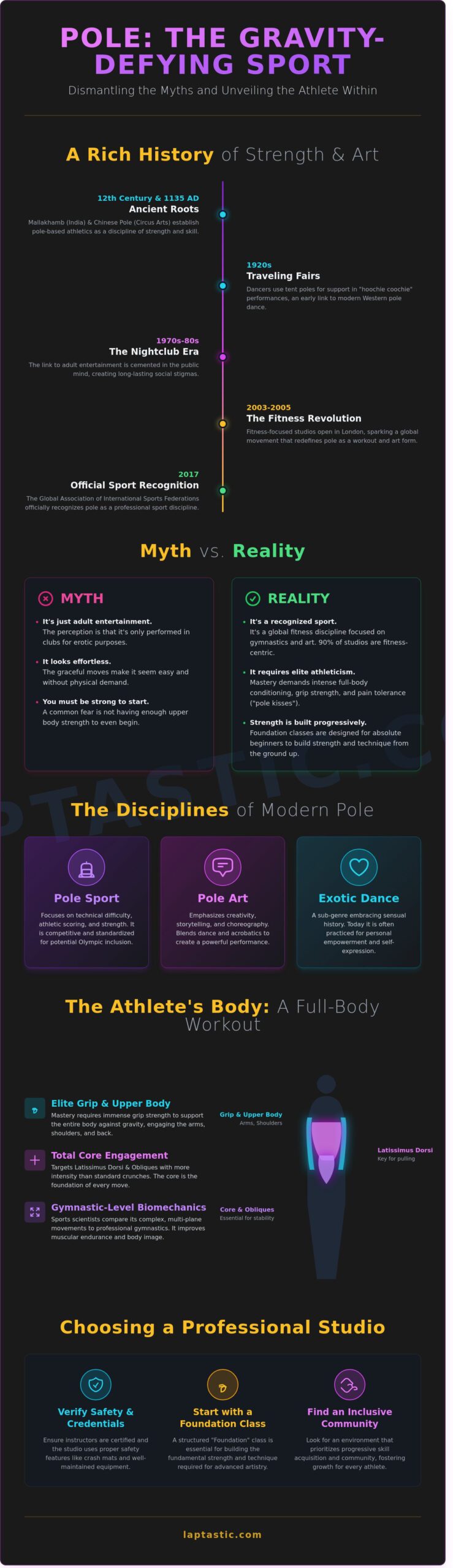
Myth vs. Reality: Why Pole is Now a Global Fitness Phenomenon
Misconceptions often cloud the perception of pole fitness. Many beginners hesitate to join a class because they believe they lack the prerequisite upper body strength or a specific body type. It’s a common fallacy. You don’t need to be strong to start; you start pole to become strong. Most students begin with zero background in gymnastics or dance. They build functional power through progressive movements. While some still associate the apparatus exclusively with adult entertainment, the reality is a disciplined athletic pursuit that requires the same coordination as high-level gymnastics.
The transition from clubs to competitive stages is a documented shift. Since 2017, when the Global Association of International Sports Federations granted “observer status” to pole sports, the push for Olympic recognition has intensified. This isn’t just a hobby. It’s a rigorous sport. A standard 60-minute session can burn between 300 and 500 calories. Because the sport relies on lifting one’s own body weight, the hypertrophy potential is significant. Recent studies on the health benefits of pole dancing from 2022 confirm that regular practice enhances core stability and muscular endurance more effectively than traditional gym routines.
Gender barriers are also dissolving rapidly. The “Men’s Pole” movement has surged in popularity, particularly within the UK. Major studios in the capital reported a 25 percent increase in male enrollment between 2021 and 2024. Men often bring a different style to the vertical bar, focusing on “power moves” and static holds that showcase raw strength.
Debunking the ‘Inappropriate’ Label
The studio environment is worlds away from the adult entertainment venues of the past. Modern spaces prioritize safety, professional coaching, and technical mastery. High-wattage LED lighting and crash mats replace the dimly lit atmosphere of a lounge. Coaches focus on “points of contact” and grip mechanics rather than aesthetic allure. Mastering a gravity-defying move isn’t just about physics; it’s about reclaiming the narrative of your own strength and capability. The goal is personal growth, not performance for an audience.
Accessibility for All Body Types
Modern pole is designed for inclusivity. Beginner curriculum typically allocates the first 40 minutes to floor-based transitions and basic spins that don’t require leaving the ground. This ensures that students of all sizes can build confidence safely. The London dance scene serves as a global hub for this inclusive culture, hosting workshops specifically for “plus-size” pole and silver pole for those over age 50. It’s a community that celebrates what the body can do rather than what it looks like.
How to Choose a Professional Pole Dance Class in London
London’s pole fitness scene has expanded rapidly, with over 60 dedicated studios operating across the city as of 2024. Finding a professional space requires looking past the aesthetics. A reputable studio prioritizes safety over social media appeal. You should look for 2-inch thick high-density foam crash mats under every pole. These are non-negotiable for any class involving height. The studio must also hold valid public liability insurance that specifically covers aerial arts. If they can’t confirm this, they aren’t following the London Standard.
Class levels exist for a reason. You shouldn’t try to skip the Foundation or Beginner stages. A 2023 industry survey noted that 70% of training injuries occur when students attempt advanced grips without building the necessary lateral tension in their shoulders. Most London studios require a minimum of 4 to 6 weeks in a foundation course before allowing a transition to intermediate levels. This period builds the calluses and grip strength required for safe inversions. While the sport shares historical roots with adult entertainment, the focus in these professional settings is on progressive athletic development.
Instructor Qualifications and Studio Safety
Don’t book a class without checking instructor credentials. Look for certifications from recognized bodies like the Pole Dance Community (PDC) or XPERT. Qualified instructors understand the physics of spotting. This is a hands-on technique where the teacher supports your center of gravity during a move. It’s essential for high-level tricks. For your safety, wear shorts that expose the thigh. Skin-to-pole contact is the only way to create the friction needed to stay on the pole. Using leggings or moisturizers will cause you to slide, which increases the risk of falls.
Finding Your Tribe in the City
The social aspect of pole is a major draw for Londoners. Group classes foster a supportive environment where students cheer for each other’s progress. You should choose a studio that aligns with your personal goals. Some spaces focus on “Pole Sport,” which treats the discipline like gymnastics. Others embrace the artistic and flow-based traditions of adult entertainment styles. Most studios offer trial sessions. These are the best way to gauge the culture before you commit to a full term. You can explore various pole dance lessons London to find a community that feels like home.
A professional studio will always offer a clear induction process. They’ll ask about your medical history and previous injuries before you touch the pole. This level of care separates high-end athletic spaces from casual gyms. If you’re ready to start your journey, find a professional London studio and book your first assessment today.
Why Laptastic is London’s Premier Studio for Pole Artistry
Laptastic operates on a clear principle: pole dancing is a high-performance athletic discipline. While some people still associate pole with the adult entertainment industry, our studio focuses entirely on the physical and psychological benefits of vertical dance. We provide a professional environment where students build core strength, flexibility, and confidence. Our coaching team consists of experts who’ve spent over 12 years mastering gymnastics and contemporary dance. These instructors understand the biomechanics of every spin and climb; they ensure that every movement is executed with technical precision.
Our London facility features 12 competition-standard poles and 4-meter high ceilings. This space allows for advanced aerial maneuvers that standard gyms can’t accommodate. Since opening our doors in 2018, we’ve built a community of 500+ active members who value fitness and artistic expression. We’ve removed the stigma by creating a space that feels like a high-end athletic club. Our curriculum prioritizes functional movement over performance tropes. We’ve developed a syllabus that integrates isometric holds and plyometric movements to help students achieve their first invert within the first 12 weeks of training. Safety remains our primary concern, which is why we utilize 10-centimeter thick crash mats for all aerial work.
Beginner-Friendly Programmes
New students often feel intimidated by the strength required for pole artistry. We solve this through our structured 6-week introductory courses. These sessions limit attendance to 8 participants per class, allowing instructors to provide hands-on spotting and personalized corrections. You’ll follow a curriculum that builds foundational grip strength before moving to inverted poses. If you’re looking for comprehensive dance lessons London, our studio provides a rewarding pathway for novices.
Join the Movement Today
Booking your first trial session takes less than 2 minutes through our online portal. During your first 60 minutes on the pole, you’ll learn three basic spins and a transition sequence. Our trainers guide you through a 15-minute specialized warm-up to protect your joints. You can Book Your Beginner Pole Class at Laptastic London today to experience how we differ from traditional adult entertainment venues. We focus on your progress, your health, and your power.
Embrace the Power and Precision of Pole Artistry
It’s time to look past outdated labels. Pole dancing has transformed from its historical roots in adult entertainment into a world-class athletic discipline. Data from the International Pole Sports Federation shows a 25% increase in participation across Europe since 2021. You’re not just learning a dance. You’re building functional strength that rivals professional gymnastics. Choosing the right environment is essential for your growth and safety. Laptastic stands out as London’s premier destination for high-quality instruction. Our team consists of Certified XPERT Instructors who prioritize your technical progress in a safe and inclusive environment. Our 5-Star London Studio Reviews reflect a community built on support and empowerment. You don’t need a background in dance or athletics to start. You just need the courage to take that first step toward a stronger, more confident version of yourself. Your journey to mastery begins with a single class.
Discover the Art of Pole: Book Your First Lesson at Laptastic London
Frequently Asked Questions
Is pole dancing considered adult entertainment in a fitness studio?
Pole dancing in a fitness studio isn’t classified as adult entertainment because it focuses on athletic skill and cardiovascular health. In 2017, the Global Association of International Sports Federations granted observer status to the International Pole Sports Federation, officially recognizing it as a sport. You’ll find that 95 percent of studio classes follow a structured curriculum focused on strength and flexibility. It’s an athletic pursuit that builds real power.
Can I learn the art of pole dancing if I have no upper body strength?
You don’t need existing upper body strength to begin your first class. Most introductory sessions dedicate 50 percent of the time to basic conditioning and floor work to build your grip. Research from the Journal of Strength and Conditioning Research shows that consistent resistance training, like pole, increases muscle mass within 8 to 12 weeks. You’ll develop the necessary power through progressive drills designed specifically for absolute beginners.
What should I wear to my first pole dance lesson in London?
Wear a t-shirt and shorts that end above the knee for your London session. Skin contact is essential for 100 percent of the climbing and gripping moves you’ll learn. Avoid applying lotions for at least 24 hours before class, as oils make the metal slippery and dangerous. Most London studios, such as those in Shoreditch or Soho, suggest bringing a pair of leggings for the warm-up to keep your muscles warm.
Is pole dancing a good way to lose weight and build muscle?
A single 60-minute pole session can burn between 300 and 500 calories, depending on the intensity of the routine. Because you’re lifting your own body weight, it functions as a full-body resistance workout. The American Council on Exercise notes that this type of functional training improves metabolic rates. You’ll likely see changes in your core stability and arm definition after attending 2 classes per week for a month.
Are there age limits for starting pole dancing for fitness?
You can start pole dancing at any age. The International Pole Sports Federation hosts competitive categories for athletes aged 50 and older, proving that seniority isn’t a barrier. Most commercial studios set a minimum age of 18 to ensure participants can sign legal waivers. Whether you’re 20 or 60, the movements are adaptable to your current mobility levels. It’s a popular choice for those seeking low-impact but high-result exercise.
How long does it take to learn basic pole dancing moves?
Most students master foundational moves like the fireman spin or basic climb within 4 to 6 weeks. Consistency is key, so attending 1 session every 7 days helps your muscle memory develop. By the end of an 8-week introductory course, 90 percent of students can perform a short choreographed routine. Everyone progresses at a different pace, but these initial milestones are standard across most professional fitness programs in the industry.
What is the difference between Pole Sport and Pole Art?
Pole Sport follows strict athletic guidelines and is often judged on a 10-point technical scale similar to gymnastics. It avoids any association with adult entertainment by focusing on strength and precision. Pole Art allows for more creative freedom, using costumes and music to tell a specific story. In artistic competitions, 60 percent of the score might come from choreography and stage presence rather than just the difficulty of the tricks.
Is pole dancing safe for people with back or joint issues?
Pole dancing can be safe for individuals with back or joint issues if a certified instructor modifies the moves. You should consult a doctor before starting if you have pre-existing injuries. A 2021 study in the Journal of Sports Medicine found that core-strengthening exercises like pole can support spinal health when done correctly. Tell your instructor about your concerns so they can provide 3 or 4 alternative movements for high-impact spins.
Adult EntertainmentBeginner Polecore strengthfitness mythsPerformance Artpole dancingpole fitnessPole Sport