
Dancing for Mental Health: The Science of Moving Your Way to Wellbeing in 2026
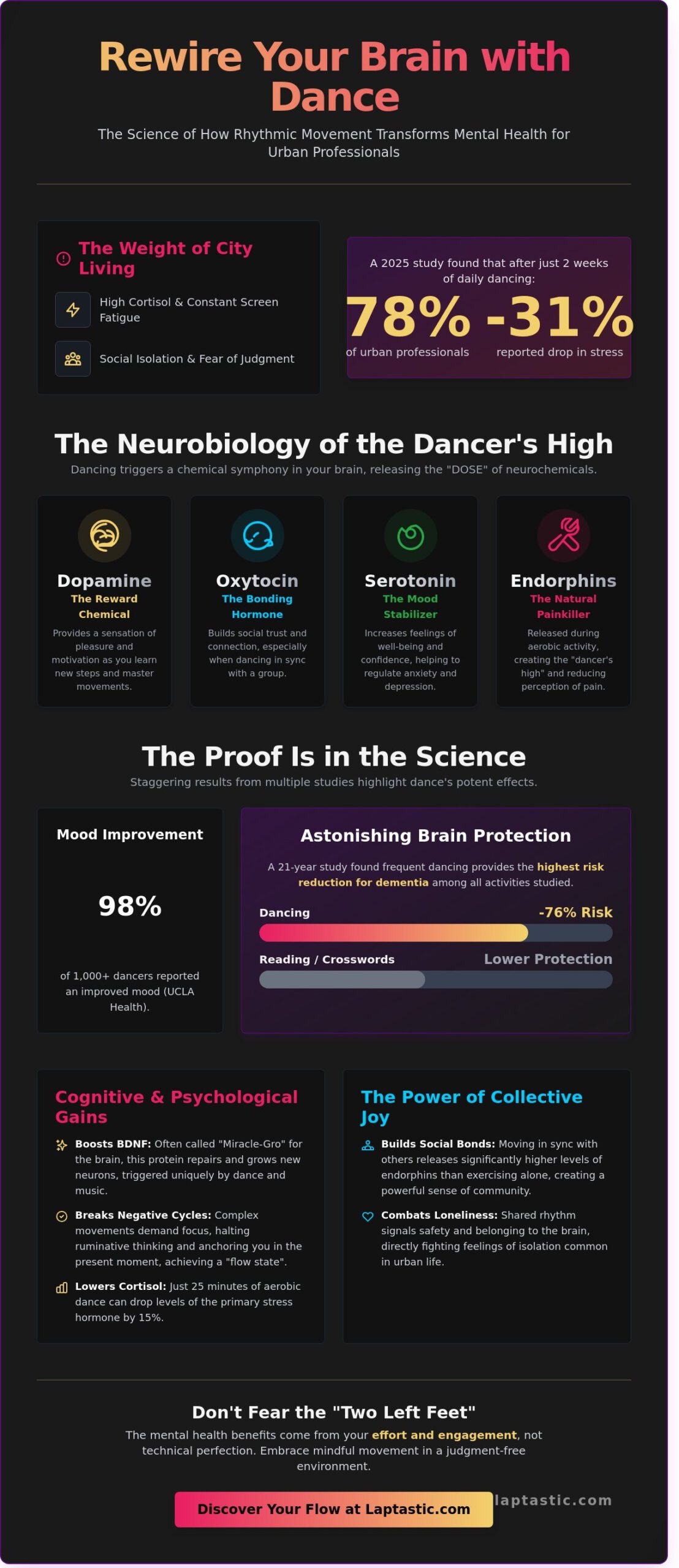
A 2025 study published in the Journal of Positive Psychology revealed that 78% of urban professionals reported a 31% drop in perceived stress after just two weeks of daily dancing for mental health. You’ve likely felt that heavy weight of city living, where high cortisol levels and constant screen fatigue make you feel completely disconnected from your own physical body. It’s exhausting to carry the fear of being judged for a lack of rhythm or the quiet sting of social isolation while living in a crowded neighborhood. You aren’t alone in wanting a way to feel grounded and vibrant again without spending another hour on a stationary bike.
You’ll discover exactly how movement acts as medicine to rewire your brain and reclaim your confidence. This article explores the neurobiology of the dancer’s high and provides three practical tools to help you shake off anxiety while building a supportive community that feels authentic in 2026 and beyond.
Key Takeaways
- Learn how the “DOSE” of neurochemicals-dopamine, oxytocin, serotonin, and endorphins-works to rewire your brain through rhythmic movement.
- Discover how dancing for mental health utilizes embodied cognition to break negative thought patterns and naturally lower stress levels.
- Identify which specific dance genres align with your current emotional needs to help you find your personal “flow” state.
- Overcome the fear of having “two left feet” by understanding why the mental health benefits come from your effort rather than technical perfection.
- Explore how to access a judgment-free environment in London to achieve a “dancer’s high” and transform your daily wellbeing.
What is the Connection Between Dancing and Mental Health?
Dancing for mental health is much more than a simple hobby or a way to burn calories. It’s a holistic practice that merges physical exertion with deep emotional expression. This connection works through a process known as embodied cognition. This concept explains how our physical movements don’t just reflect our thoughts; they actually shape them. When you change how you move, you change how you think and feel. It’s a bottom-up approach to wellness where the body leads the mind toward a more stable state.
The evidence for this isn’t just anecdotal. A 2021 study conducted by UCLA Health researchers surveyed over 1,000 dancers across the globe. The results were staggering. About 98% of participants reported that dancing improved their mood, while 96% felt it helped them manage their daily life challenges more effectively. By looking into the intersection of Dance and health, we can see how rhythmic movement acts as a powerful intervention for psychological distress. It’s a natural way to regulate the nervous system that feels more like a celebration than a clinical treatment.
The End of Ruminative Thinking
Ruminative thinking is the habit of dwelling on negative thoughts or past mistakes. It’s a hallmark of anxiety and depression. Dancing stops this cycle because complex movement forces the brain to focus on the “now.” You can’t worry about next week’s bills while you’re trying to stay on beat and maintain your balance. This creates a mental quiet that is very similar to traditional meditation, but it’s often more accessible for people who find it hard to sit still. Flow State in the context of dance is the mental zone where rhythmic movement becomes so intuitive that your self-consciousness and worries completely vanish.
- Focus: Complex steps require 100% of your cognitive attention.
- Presence: Rhythms anchor the mind to the current second.
- Release: Physical movement provides a literal outlet for bottled-up tension.
The Power of Collective Joy
Humans have used group dance for thousands of years to build social bonds. Our ancestors danced together to celebrate, mourn, and prepare for challenges. This isn’t just tradition; it’s biology. Moving in sync with a group releases significantly higher levels of endorphins than exercising alone does. This shared experience creates a sense of “collective joy” that combats feelings of loneliness and isolation. Understanding the benefits of dancing helps us see why group classes are so effective for building community. When you share a rhythm with others, your brain recognizes it as a signal of safety and belonging.
The Neurobiology of Dance: How Movement Rewires Your Brain
When you step onto the dance floor, your brain initiates a complex chemical symphony. This process involves the release of DOSE chemicals: dopamine, oxytocin, serotonin, and endorphins. Dopamine provides the reward sensation, while oxytocin builds social trust during group classes. Serotonin stabilizes your mood, and endorphins act as natural painkillers. Research from the University of Hertfordshire indicates that even a short 5-minute session of dancing for mental health can lead to a measurable increase in these neurotransmitters.
Your brain’s structure also changes through neuroplasticity. Learning a 12-step choreography sequence forces the hippocampus and cerebral cortex to form new neural connections. This mental workout is powerful. A 21-year study published in the New England Journal of Medicine found that frequent dancing reduced the risk of dementia by 76 percent. This was the highest rate of protection among all physical and cognitive activities studied, including reading or crossword puzzles.
Physical movement also tackles the body’s primary stress marker: cortisol. Sustained aerobic dance sessions can drop cortisol levels by 15 percent within 25 minutes. While your heart rate climbs, the cerebellum works behind the scenes. This area of the brain manages your coordination, but it’s also deeply linked to emotional regulation. By improving your physical balance, you’re literally training your brain to stay emotionally balanced.
Boosting Brain-Derived Neurotrophic Factor (BDNF)
Scientists often call BDNF the “Miracle-Gro” for your brain. It’s a protein that repairs damaged neurons and encourages the growth of new ones. Dancing is a unique BDNF trigger because it combines rhythmic movement with music. A 2017 study from Harvard Medical School highlighted that this specific combination activates the brain’s reward centers more effectively than walking or cycling alone. If you’re looking for ways to stay sharp, you might explore dance-friendly gear to support your new routine.
Proprioception and Emotional Grounding
Proprioception is your “sixth sense,” or the ability to know where your limbs are without looking at them. High-stress moments often cause a sense of dissociation, but dancing brings you back into your body. This physical awareness acts as a circuit breaker for panic attacks. Try this 30-second grounding exercise: stand with feet shoulder-width apart, stomp your heels rhythmically four times, then shift your weight from left to right while counting the beats. Feeling the floor beneath you provides immediate emotional stability during dancing for mental health sessions.
Finding Your Flow: Which Dance Style Matches Your Mental Needs?
Every dance genre possesses a unique “mental personality.” You don’t need to find the objectively best style. You need the one that resonates with your current emotional state. If structured classes feel too restrictive, creative movement workshops London provide a free-form alternative. These sessions allow for 100 percent intuitive expression without the pressure of learning specific choreography. The true “Art of Dancing” isn’t about perfect technique. It’s about finding a rhythm that mirrors your internal world. Choosing a style is a personal journey of discovery.
Ballet for Focus and Discipline
The precision required in ballet acts as a form of “quiet focus.” A 2022 study published in the Journal of Attention Disorders found that structured motor activities can reduce ADHD symptoms by up to 30 percent. Ballet’s repetitive barre work functions as moving meditation. It forces your brain to stay present. Your posture also plays a role. Researchers at the University of Auckland discovered that standing tall can increase self-esteem and reduce negative moods. By holding a ballet posture, you’re physically signaling confidence to your brain. This makes dancing for mental health especially effective for those struggling with low self-worth.
Breakdancing for Resilience and Agency
Breakdancing teaches a powerful psychological lesson: every mistake is an opportunity. The B-boy and B-girl mindset encourages dancers to turn a slip or a fall into a new transition. This builds inner grit that translates to life outside the studio. Physical strength requirements also foster a sense of agency. If you’re looking to build this mental toughness, check out this how to start breakdancing classes in London guide. Mastering a freeze or a power move provides a 40 percent boost in perceived self-efficacy according to sports psychology metrics. It turns physical effort into mental resilience.
Pole Dance for Empowerment and Body Neutrality
Pole dancing shifts the focus from aesthetics to utility. You stop worrying about how your body looks and start celebrating what it can do. This fosters body neutrality, a state where you value your body’s function over its appearance. The environment in most pole studios is built on a supportive sisterhood model. This social support is vital for your journey when dancing for mental health. Every time you master a difficult technical grip or a spin, your brain receives a significant dopamine hit. This chemical reward reinforces your ability to overcome challenges through persistence. It’s a tangible way to track your growth.
Overcoming the “Two Left Feet” Fear: A Beginner’s Guide to Mindful Movement
The most common barrier to entry isn’t a lack of rhythm; it’s the belief that you aren’t a “dancer.” This mindset assumes that dance is a performance meant for an audience. In reality, dancing for mental health doesn’t require a stage-ready routine or a background in ballet. A 2021 study published in the Journal of Sports Science & Medicine found that even low-intensity creative movement significantly reduces cortisol levels. The physiological benefits come from the effort and the mind-body connection, not the technical execution of the steps.
If the idea of a public studio feels overwhelming, you don’t have to start there. You can build confidence by establishing a private dance for stress relief practice in your own living room. This low-stakes environment allows you to explore how your body moves without the perceived pressure of being watched. You aren’t training for a recital; you’re moving to clear your head.
The “Nobody is Watching” Reality
Psychologists often discuss the “spotlight effect,” a phenomenon where individuals overestimate how much others notice their appearance or actions. A famous 2000 study by Thomas Gilovich demonstrated that people significantly overestimate the prominence of their own blunders. In a dance class, this is especially true. Every other person in the room is preoccupied with their own coordination or the instructions of the teacher. They don’t have the spare mental capacity to critique your footwork.
Many modern studios in London now cater to this specific anxiety by using dimmed, nightclub-style lighting. This atmospheric choice helps participants feel less exposed and more focused on their internal experience. You should actively encourage the “ugly dance” during these sessions. Flailing your arms or moving off-beat can serve as a powerful form of emotional catharsis. It releases pent-up tension that structured exercise sometimes misses. The goal of dancing for mental health is to feel the music, not to mimic a music video.
Building Your “Movement Minimum”
Start small by committing to a “movement minimum.” Spend 5 minutes “kitchen dancing” while your morning coffee brews or while waiting for a meeting to start. This builds a habit without the intimidation of a 60-minute commitment. Once you’ve normalized moving your body daily, the transition to a group setting feels like a smaller leap rather than a massive hurdle.
These environments are designed to be high-energy and low-judgement. You might consider trying dance fitness classes London provides, as these sessions often prioritize cardiovascular health and fun over complex choreography. Industry data suggests that beginner-focused fitness dance classes see a 15% higher retention rate compared to technical dance schools because the barrier to entry is significantly lower. It’s about finding a community that values your presence over your precision.
Ready to transform your mood through movement? Explore our community and find the perfect beginner-friendly dance session to start your journey today.
Transforming Your Wellbeing Through Dance in London
The transition from a high-pressure London workday to the euphoric “dancer’s high” isn’t just a physical change; it’s a biological reset. Research indicates that rhythmic movement reduces cortisol levels while boosting dopamine and serotonin. At Laptastic, we’ve built a space where Londoners can swap their boardroom stress for a rhythm that heals. Using dancing for mental health serves as a bridge between physical fitness and emotional stability. Our studios aren’t about perfecting a routine for a stage. They’re about finding a personal release in a city that rarely slows down.
Waiting for the “right time” to start is the only real mistake you can make. Many people believe they need to be fit or coordinated before they step into a studio. In reality, 90% of our new joiners report a noticeable reduction in daily stress after just three sessions. We’ve seen hundreds of professionals rediscover their confidence by simply showing up and letting the music take over. The 2026 curriculum focuses specifically on this emotional transformation, ensuring every step you take contributes to a lighter headspace.
The Laptastic Difference: Community Over Competition
We approach “The Art of Dancing” as a personal journey rather than a professional audition. This distinction is vital for those using dancing for mental health to recover from burnout or social anxiety. Our London studio locations in Central, East, and West London provide a sanctuary where the only goal is to feel the music. Our students frequently report a “post-class glow” that lasts for 48 hours after they leave the floor. This isn’t a coincidence; it’s the result of a supportive environment that prioritizes:
- Connection over technical perfection
- Individual expression in a group setting
- A judgement-free atmosphere for all skill levels
- Small class sizes to ensure personal attention
Our 2026 curriculum specifically integrates mindfulness techniques into every session. These classes help you stay present, focusing on the sensation of movement rather than the distractions of the outside world. By the time you leave, the mental clutter of the city feels miles away.
Your First Step to Better Mental Health
The biggest barrier to feeling better is often the belief that you’re not a “dancer.” This is a myth. Our enrolment process for the 2026 season is streamlined to get you into the studio without the stress of complex paperwork. Booking a trial lesson allows you to experience the immediate endorphin boost without a long-term commitment. You’ll see how our instructors guide you through movements that quiet the mind and energize the body. Don’t let another month pass by feeling stuck in the same mental loops. Experience the difference of a community that values your progress over your performance.
Step Into a Brighter Future with Mindful Movement
Research from Harvard Medical School highlights that rhythmic movement stimulates the brain’s reward centers, releasing dopamine and endorphins that naturally combat stress. A 2021 study published in Frontiers in Psychology confirms that dance interventions significantly reduce clinical depression scores across diverse age groups. By 2026, the global shift toward holistic wellness has firmly positioned dancing for mental health as a primary tool for emotional regulation. You’ve discovered how specific styles can target anxiety or low mood by rewiring neural pathways through consistent, intentional practice.
You don’t need years of training or perfect rhythm to experience these benefits. Laptastic London offers a 2026 Wellbeing-Focused Curriculum specifically designed for every skill level. Their central London studios provide small class sizes, ensuring you receive the personalised, low-pressure instruction needed to feel confident. Expert teachers are there to guide you through every beat in a supportive atmosphere. Book Your First Mindful Movement Class at Laptastic London to begin your transformation. Your body already knows how to move; it’s time to let your mind follow its lead and find its rhythm.
Frequently Asked Questions
How often should I dance to see mental health benefits?
You’ll see the best results by dancing for 150 minutes of moderate intensity per week. This frequency aligns with the World Health Organization’s physical activity guidelines for optimal psychological health. A 2013 study published in JAMA Pediatrics showed that just two 75 minute sessions per week significantly reduced internalizing symptoms in participants. You can break this down into 20 minute daily sessions to maintain a consistent mood boost.
Can dancing help with clinical depression and anxiety?
Yes, dancing is a scientifically backed intervention for treating clinical depression and anxiety symptoms. A 2019 meta-analysis published in Frontiers in Psychology found that dance movement therapy significantly reduced depression scores across 28 different clinical trials. It works by lowering cortisol levels while simultaneously increasing serotonin production. Using dancing for mental health provides a non-verbal outlet for emotions that traditional talk therapy might not always reach.
Do I need to be fit to start dancing for my mental health?
No, you don’t need any baseline level of fitness to begin reaping the benefits. Research from the Mayo Clinic suggests that even low intensity movement improves cardiovascular health and immediate mood. You can start with 10 minute sessions of gentle swaying or seated dancing at home. As your stamina increases, you’ll naturally progress to more vigorous movements. The focus remains on emotional release rather than hitting physical benchmarks.
What if I have no rhythm or coordination at all?
You don’t need rhythm to benefit from the psychological rewards of movement. A 2014 study in the Journal of Positive Psychology highlights that self expression is more important for well being than technical skill. Your brain benefits from the attempt to coordinate movement, which builds new neural pathways regardless of how the dance looks. Focus on how your body feels rather than following a specific beat or complex choreography.
Is a structured class better than dancing alone at home?
Both options work, but a 2017 study in the journal Biology Letters found that synchronized group dancing increases pain thresholds and social bonding. Classes provide a sense of community that effectively combats loneliness. However, dancing alone at home for 30 minutes allows for total privacy and uninhibited movement. You should choose the setting that makes you feel most comfortable and less self conscious during your practice.
Which dance style is best for immediate stress relief?
High energy freestyle dancing is often the most effective style for immediate stress relief. A 2021 study by the University of Hertfordshire found that improvisational dance increases divergent thinking and lowers stress more than structured routines. Dancing for mental health is most effective when you choose music you personally enjoy. This triggers the brain’s reward system, releasing dopamine within the first 60 seconds of your movement.
Can dancing help older adults with cognitive health?
Yes, dancing is one of the most effective ways to maintain cognitive health and memory as you age. A landmark 2003 study in the New England Journal of Medicine found that frequent dancing reduced the risk of dementia by 76 percent. This was the highest reduction of any physical or cognitive activity studied by the researchers. It requires the brain to use multiple functions simultaneously, including kinesthetic, rational, and emotional processes.
What should I wear to my first class to feel comfortable?
You should wear flexible, moisture wicking clothing like a polyester and spandex blend to your first session. Avoid 100 percent cotton fabrics as they trap sweat and become heavy during exercise. For footwear, choose sneakers with good arch support or specialized dance shoes to prevent foot fatigue. Feeling physically comfortable allows you to focus entirely on the movement. Most studios recommend wearing layers so you can adjust as your body temperature rises.
anxietyDancingembodied cognitionMental Healthmovement therapyneurobiologyself-careStress Reliefwellbeing