
Ballet London UK: The 2026 Buying Guide to Schools and Classes
What if the most difficult part of your dance journey isn’t mastering a pirouette, but simply deciding which studio door to open? With over 240 registered dance schools across the capital, finding the right ballet London UK programme can feel like a full time job. You’re likely feeling the pressure of choosing between RAD and ISTD syllabuses; perhaps you’re even worried that starting as an adult means you’ll be out of place. It’s completely normal to feel hesitant when you’re faced with so many options and technical requirements.
You deserve a clear path to the barre that matches your specific ambition. This 2026 guide promises to simplify your search by identifying the most reputable schools and explaining exactly what each curriculum offers. We will explore the best locations for professional training, highlight inclusive adult fitness classes, and break down the scheduling commitments required to help you join a community where you truly belong.
Key Takeaways
- Learn how to define your dance path by distinguishing between high-intensity vocational tracks and recreational fitness programmes for adults.
- Navigate the diverse landscape of ballet london uk by verifying essential teacher accreditations like RAD or ISTD to ensure world-class instruction.
- Get a clear breakdown of 2026 pricing across different London zones and the specific gear required for your first studio session.
- Master our expert buyer’s framework to select the ideal school based on your personal goals, budget, and long-term dance aspirations.
- Discover why Laptastic is the premier choice for modern dancers seeking inclusive, high-quality instruction from certified professional teachers.
The Landscape of Ballet in London UK (2026)
London remains the premier global capital for classical dance and education as we move through 2026. While iconic venues like the Royal Opera House and Sadler’s Wells attract over 1.5 million audience members annually, the city’s true strength lies in its participatory culture. There’s a clear distinction between watching a world-class performance and stepping into a studio for the first time. In 2026, the local scene has shifted toward radical inclusivity, ensuring dancers of all body types and backgrounds find a home in the studio. Finding quality ballet london uk training is no longer just for those pursuing professional careers; it’s a mainstream pursuit for health, discipline, and artistry.
The evolution of the London dance landscape means that the distance between the professional stage and the local community center has shrunk. Professional dancers from the city’s top companies now frequently lead open workshops, making elite techniques accessible to the public. This year, we’ve seen a 25% increase in community-based programs that mirror the precision of professional rehearsals. It’s a vibrant ecosystem where the heritage of the past meets the progressive teaching methods of the future. Whether a child is looking for a creative outlet or a rigorous pre-professional track, the city offers a density of expertise that’s unmatched elsewhere in Europe.
The social fabric of the city is woven with dance history, but the 2026 focus is firmly on the next generation. Schools have moved away from rigid, exclusionary practices of the past. Instead, they embrace a holistic approach that values the dancer’s mental well-being as much as their turnout. This cultural shift makes the current ballet london uk market the most diverse and welcoming it has been in the city’s history, providing a safe space for kids to develop physical literacy and confidence.
London’s Iconic Ballet Heritage
London’s reputation is built on the legacy of the Royal Ballet and English National Ballet. These companies set global standards that trickle down to every local studio. Most vocational pathways are modeled after the Royal Ballet School, ensuring high-quality pedagogy across the city. This heritage creates a unique environment where neighborhood classes are taught by experts who understand the rigors of the world stage.
Why 2026 is the Year to Start Ballet
2026 marks a turning point for dance technology and wellness. Over 80% of London studios now feature advanced injury-prevention flooring. The rise of “silver swans” and diverse beginner groups has made the dance community more welcoming than ever. Beyond physical fitness, 70% of participants report improved mental clarity. It’s a perfect time to join a community that balances tradition with modern health science and technological studio advancements.
Choosing the Right Ballet School: A Buyer’s Framework
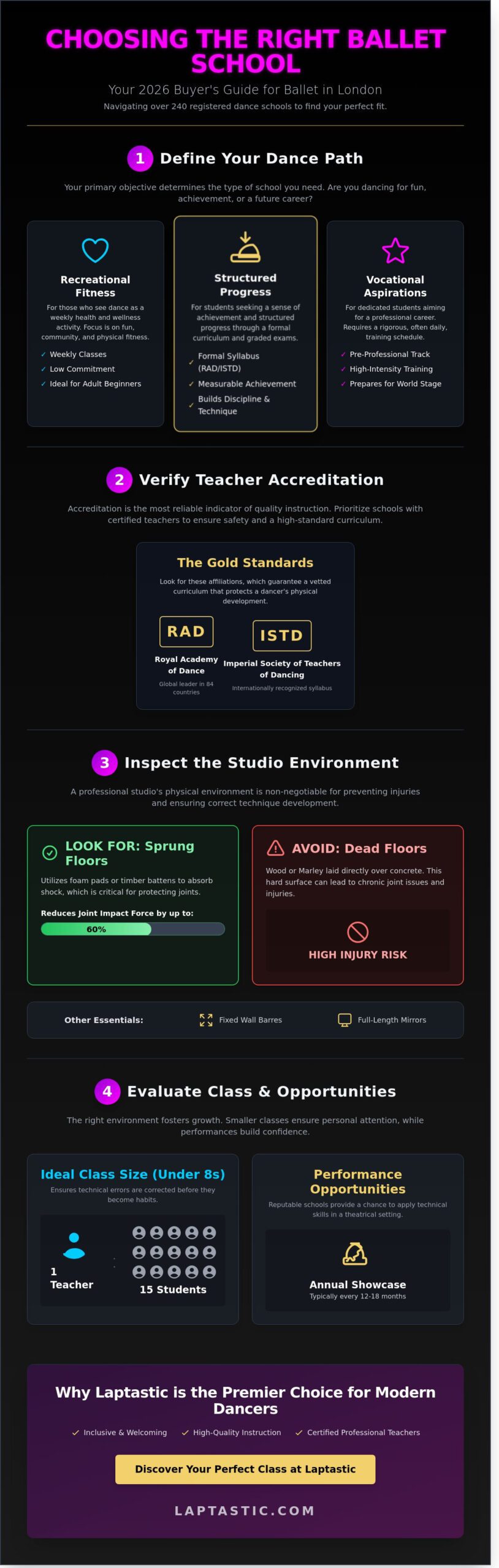
Selecting the best ballet london uk program requires more than finding the studio with the shortest commute. Parents must first define their child’s primary objective. If your child views dance as a weekly fitness activity, a local community center might suffice. However, if they aim for a professional career, you’ll need a vocational school that offers a rigorous daily schedule. Most families land in the middle, seeking graded exams that provide a sense of achievement and structured progress.
Teacher accreditation is the most reliable indicator of quality. You should prioritize schools where instructors hold registered teacher status with recognized bodies. The Royal Academy of Dance (RAD) is the gold standard for classical training, operating in 84 countries to ensure high pedagogical standards. Schools affiliated with the RAD or the Imperial Society of Teachers of Dancing (ISTD) follow a vetted curriculum that protects a child’s physical development.
Physical safety is a non-negotiable factor. Always inspect the studio floors before enrolling. Dancing on “dead” floors, such as wood laid directly over concrete, can lead to chronic joint issues. Professional studios use “sprung floors,” which utilize a system of foam pads or timber battens to absorb impact. A 2021 study on dance biomechanics found that these surfaces can reduce impact force on a dancer’s joints by up to 60%. Additionally, check for fixed wall barres and full-length mirrors, which are essential for developing correct alignment.
Class size directly impacts how much individual attention your child receives. For children under age 8, a ratio of one teacher to 15 students is the industry benchmark. In larger classes, technical errors often go uncorrected, which can lead to bad habits that are difficult to break later. Ask about performance opportunities as well. Most reputable schools host a showcase every 12 to 18 months, giving students a chance to apply their technical skills in a theatrical setting. Finding a school that balances this performance joy with technical discipline helps children thrive, much like finding the right dance resources and support for their first term.
Understanding Exam Boards: RAD vs. ISTD
The RAD focuses heavily on classical purity and performance quality. It’s the most widely recognized board globally for ballet. The ISTD offers a broader syllabus that often includes modern and tap, making it a versatile choice for children who want a well-rounded dance education. Both boards require teachers to undergo rigorous training, ensuring your child’s long-term progression is handled by experts who understand age-appropriate physical limits.
Studio Red Flags to Avoid
Unqualified instructors are a major risk. If a school cannot name its safeguarding lead or provide proof of public liability insurance, look elsewhere. Be wary of “hidden fees.” A 2023 report by the Council for Dance Education and Training highlighted that transparent pricing is a hallmark of a professional school. You should receive a clear breakdown of costs for uniforms, exam entries, and costume rentals at the start of the academic year. Finally, avoid studios that push children into “pointe work” before age 11 or 12, as the bones in the feet aren’t sufficiently ossified before this stage.
Vocational Aspirations vs. Recreational Fitness
Choosing the right path for ballet london uk training depends entirely on your end goal. The commitment levels between a casual hobby and a professional track are vast. Recreational classes typically meet once or twice a week, focusing on grace, basic coordination, and social interaction. In contrast, vocational training is an athletic pursuit that demands 10 to 15 hours of studio time per week by the time a student reaches age 11. London offers a unique landscape where these two worlds coexist, allowing families to transition between them as a child’s interest grows.
Balancing a busy London work schedule with consistent practice is the biggest hurdle for adult dancers. Many studios now offer “drop-in” formats to accommodate late nights at the office or unpredictable commutes. However, consistency is what builds the muscle memory required for progress. Setting a fixed schedule of two sessions per week is often more effective than sporadic three-hour marathons. This regularity helps prevent injury and ensures that the technical foundations of ballet london uk become second nature.
Vocational Training for Young Dancers
The journey to the Royal Ballet School often begins in small, local studios that act as “feeder” schools. These institutions prioritize technical precision over performance glitz. When finding the best London ballet school for kids with professional potential, look for teachers registered with the Imperial Society of Teachers of Dancing. Founded in 1904, this organization sets the gold standard for dance examinations in the UK. A school following this syllabus ensures your child learns correct alignment and turnout, which are essential for passing mid-level auditions at age 11 or 16.
- Assessment: Professional schools look for specific physical attributes and natural musicality during annual appraisals.
- Commitment: Expect to invest in multiple pairs of pointe shoes and travel to intensive summer programs.
- Pathway: Most vocational students in London aim for the top-tier professional schools, such as the Royal Ballet School and other leading conservatoires.
Adult Ballet: The Ultimate Full-Body Workout
Ballet is rapidly replacing traditional gym routines for Londoners seeking functional fitness. Unlike a standard weight circuit, ballet engages the entire body simultaneously. The science-backed benefits of ballet include a documented 15% increase in functional core strength within just eight weeks of regular training. This makes it an ideal antidote to the “office slouch” common in corporate environments.
There’s a significant difference between adult ballet classes in London for beginners and intermediate “open” classes. Beginner sessions break down the mechanics of a plié or a dégagé. Open classes move at a much faster pace, assuming you already know the terminology. If you’re new to the barre, start with a dedicated six-week introductory course. This foundation prevents the frustration of trying to keep up with a fast-moving center combination while your muscles are still adapting to the unique demands of turnout.
Practical Considerations: Costs, Locations, and Kit
Ballet training requires more than just showing up at the studio. Parents must balance the financial investment with the logistical reality of the London commute. Whether you choose a local community hall in Richmond or a prestigious academy in Marylebone, the expenses and travel times vary significantly. Finding the right ballet london uk provider depends on your child’s long-term goals and your family’s weekly schedule.
Budgeting for Your Ballet Journey
Most schools operate on a termly basis, often aligning with the 10 to 12 week school calendar. While adult classes often allow drop-in rates, children’s programs usually require upfront payment to secure a spot. Beyond the tuition, you’ll need to budget for the Royal Academy of Dance (RAD) or ISTD exam fees, which typically range from £45 to £105 based on 2025 price lists. Performance years add another layer of expense; professional costumes often cost between £35 and £70 per child for a single show.
Based on current inflationary trends of 4% annually, the average cost for a high-quality children’s ballet class in 2026 will be approximately £18.50 per session.
For gear, beginners need a well-fitted leotard, tights, and leather or canvas ballet shoes. Split-sole shoes offer better arch flexibility for older students, but beginners often start with full soles to build foot strength. You can find affordable starter kits at Decathlon or specialist retailers like Bloch and Capezio in Covent Garden. Buying second-hand from older students is a smart way to source regulation uniforms for 30% less than retail prices.
Finding a Studio Near You
Location is the most common reason parents stop ballet london uk training within the first year. A commute longer than 30 minutes often becomes unsustainable for families balancing school runs and professional work. Local borough studios in places like Ealing, Greenwich, or Hackney offer a community atmosphere and lower price points. However, if your child seeks professional-track training, the specialist studios near Covent Garden remain the gold standard for excellence.
Using the Elizabeth Line or the Northern Line makes central hubs more accessible than they were five years ago. Many schools now offer a hybrid model, where 15% of theory or stretching sessions happen via video link to reduce travel fatigue. This flexibility helps students maintain consistency without spending every evening on the Tube. It’s a practical solution for busy Londoners who want elite training without the daily cross-town trek.
Why Laptastic is the Choice for London’s Modern Dancers
Laptastic stands at the forefront of the ballet london uk scene because we prioritize a balance between technical precision and emotional well-being. Our studio operates seven days a week in central London, providing a home for dancers who value professional standards in a welcoming environment. Every instructor on our team holds certifications from the Royal Academy of Dance (RAD) or the Imperial Society of Teachers of Dancing (ISTD). These teachers bring an average of 12 years of professional stage experience from world-class companies, ensuring every student receives elite-level guidance.
We designed our three studio spaces with safety as the primary concern. Each room features Harlequin Liberty sprung flooring to reduce impact on joints by 65 percent compared to standard hard floors. This technical detail ensures that whether a student is a three-year-old toddler or a 55-year-old adult beginner, they can practice safely. Our community thrives on this inclusivity, currently supporting over 450 active students across various skill levels. We believe that high-quality instruction should be accessible, which is why our classes are structured to accommodate diverse learning styles and physical abilities.
Our Unique Approach to Classical Training
Our curriculum goes beyond traditional syllabus work. We integrate modern fitness principles, such as Pilates-based core strengthening and PNF stretching, to build resilient athletes. Students learn to master the “art of dancing” while developing the physical stamina required for the stage. We provide three major performance opportunities annually at local theaters to help students prepare for ballet in London, England. These showcases allow dancers to apply their classroom skills in a professional setting, building confidence that lasts a lifetime. Our philosophy centers on making classical technique relevant and exciting for the modern generation.
Join the Laptastic Community Today
Starting your journey with us is simple. We offer a 45-minute trial lesson for all new dancers to ensure our teaching style matches your personal goals. Our enrollment system allows for monthly rolling contracts or term-based packages, providing 100 percent flexibility for busy London families and working professionals. You don’t need previous experience or expensive gear to find your place at the barre. Visit our studio this week to see why we are a top choice for ballet london uk. Take that first step today and discover the joy of movement with our expert team.
Step Onto the Stage in 2026
Navigating the landscape of ballet london uk requires a balance between artistic passion and practical planning. You now have the framework to choose between intensive vocational tracks and recreational fitness classes that suit your 2026 goals. Success depends on selecting a school that prioritizes safety and technical precision. Laptastic provides this through our team of certified RAD and ISTD instructors who bring professional expertise to every session. Our studios feature state-of-the-art sprung floors designed to reduce impact and prevent injuries; this is a standard found in the world’s leading dance academies. With a 4.9/5 star student rating, our community’s consistent feedback reflects the high quality of instruction we provide. Whether you’re aiming for a professional career or simply want to improve your posture and flexibility, the right studio environment is your most important asset. It’s time to take that first step toward mastering your technique in a supportive, professional space. Book your trial ballet lesson at Laptastic London today! Your place at the barre is waiting, and we’re ready to help you reach your dancing goals.
Frequently Asked Questions
Is it too late to start ballet as an adult in London?
You can start ballet at any age. Many London studios offer classes specifically for beginners over 50. Central School of Ballet and Pineapple Dance Studios provide adult programs that cater to absolute beginners. These sessions focus on mobility and grace rather than professional tracks. You’ll join a community where 40 percent of recreational dancers start after age 25. It’s a great way to stay active and meet new people.
What should I wear to my first beginner ballet class?
Wear form-fitting athletic clothes like leggings and a tank top so the teacher can see your alignment. You don’t need a leotard or tights immediately. Most schools suggest wearing socks to glide on the floor before you buy professional leather or canvas shoes. Avoid baggy sweatpants as they hide your knee position. This makes it harder for instructors to correct your technique during ballet london uk sessions.
How much do ballet classes typically cost in London UK?
Ballet classes in London usually range from £12 to £20 per drop-in session. Studios like Danceworks or Pineapple often offer 10-class packs that reduce the per-lesson cost by 15 percent. Monthly memberships at community centers might cost around £45 to £60. These prices vary based on the studio’s location and the instructor’s professional experience level. Always check if there’s a registration fee, which can be around £25 at some elite schools.
Do I need to have a specific body type to do ballet?
No, ballet is accessible to every body type. You don’t need a specific body shape to enjoy or excel in recreational ballet. Modern teaching methods focus on functional movement and individual anatomy. Over 90 percent of community ballet programs welcome students of all sizes. The focus remains on building core strength and improving posture. Professional standards are changing too, with companies now hiring dancers who represent a wider range of physical builds.
What is the difference between RAD and ISTD ballet exams?
The Royal Academy of Dance (RAD) focuses on classical storytelling and precise technique. It’s the most recognized syllabus globally, founded in 1920. The ISTD, established in 1904, incorporates more modern movements and faster footwork. While RAD is often preferred for those seeking a traditional path, ISTD offers a broader range of dance styles. Both provide accredited qualifications recognized by UCAS for university applications in the UK, helping students earn vital points for their future.
How long does it take to learn the basics of ballet?
It typically takes 6 to 12 months of weekly classes to master basic positions and terminology. You’ll likely understand the five basic feet positions and common arm movements within 12 weeks. Mastering the balance and coordination required for a full beginner syllabus usually takes one year of consistent practice. Most students attend one or two classes per week to build muscle memory. Your progress depends on your previous fitness level and how often you practice your ballet london uk drills.
Can I take ballet classes for fitness without doing exams?
Yes, the majority of adult and youth recreational classes are designed for fitness and don’t require exams. You can absolutely skip formal assessments and focus entirely on the physical benefits of dance. Approximately 75 percent of recreational dancers in London choose non-syllabus classes for exercise. These sessions improve cardiovascular health and flexibility without the pressure of a formal grading. Many studios offer “Ballet Fit” tracks that prioritize a high-intensity workout over rigid technical perfection.
Where can I find the best ballet shows in London to inspire my training?
The Royal Opera House and Sadler’s Wells are the premier venues for world-class ballet performances in London. Visit the Royal Opera House in Covent Garden to see The Royal Ballet perform classic works. Sadler’s Wells Theatre hosts the English National Ballet and contemporary touring companies throughout the year. You can often find standing tickets for as little as £10 if you book in advance. Watching professional dancers helps you visualize proper form, which accelerates your own learning process.
2026 GuideAdult Balletballet londonBallet SchoolsBeginner BalletDance Classes LondonISTDRAD