
How to Start Breakdancing Classes in London: A 2026 Beginner’s Guide
What if the only thing stopping you from hitting a windmill isn’t your age, but a simple lack of a clear starting line? Over 40% of new students in local studios are adults starting from scratch, yet many people still feel they’ve missed the boat or lack the coordination to join the breakdancing classes london offers. It’s normal to worry about landing wrong or confusing breaking with other street styles like popping. You want to move, but the fear of looking out of place keeps you on the sidelines.
This guide changes that by providing a 180 day roadmap to mastering the art in 2026. You’ll learn exactly how to find the right studio, ensuring you choose a space that prioritizes safety and community. We’ll break down the four essential pillars of the dance and teach you 3 basic moves you can practice in your living room right now. We’re going to explore everything from essential gear to what your very first hour in a professional studio will actually look like.
Key Takeaways
- Explore the evolution of London’s breaking culture and how its recent Olympic recognition has transformed the city into a premier global hub for dance academies.
- Master the fundamental pillars of the dance, including Toprock and Footwork, to build a solid foundation of rhythm and floor-based technique.
- Learn how to select the best breakdancing classes london has to offer by aligning your personal fitness or competitive goals with the right studio environment.
- Follow a step-by-step guide to your first moves, such as the Indian Step and Kick-Step, to start developing your unique style from your very first session.
- Discover how professional coaching and structured leveling at Laptastic London can safely transition you from a complete beginner to a confident performer.
Understanding the London Breakdancing Scene in 2026
London’s relationship with breaking began in the early 1980s, specifically on the cobblestones of Covent Garden where the first generation of UK b-boys and b-girls gathered. Fast forward to 2026, and the landscape has transformed. Following the global spotlight of the 2024 Paris Olympics, the city has solidified its status as the primary hub for European breaking talent. The culture has matured from a misunderstood street art into a disciplined athletic pursuit supported by world-class academies. To truly appreciate this growth, it’s helpful to look at the history of breakdancing and how it evolved from South Bronx block parties into a televised Olympic sport.
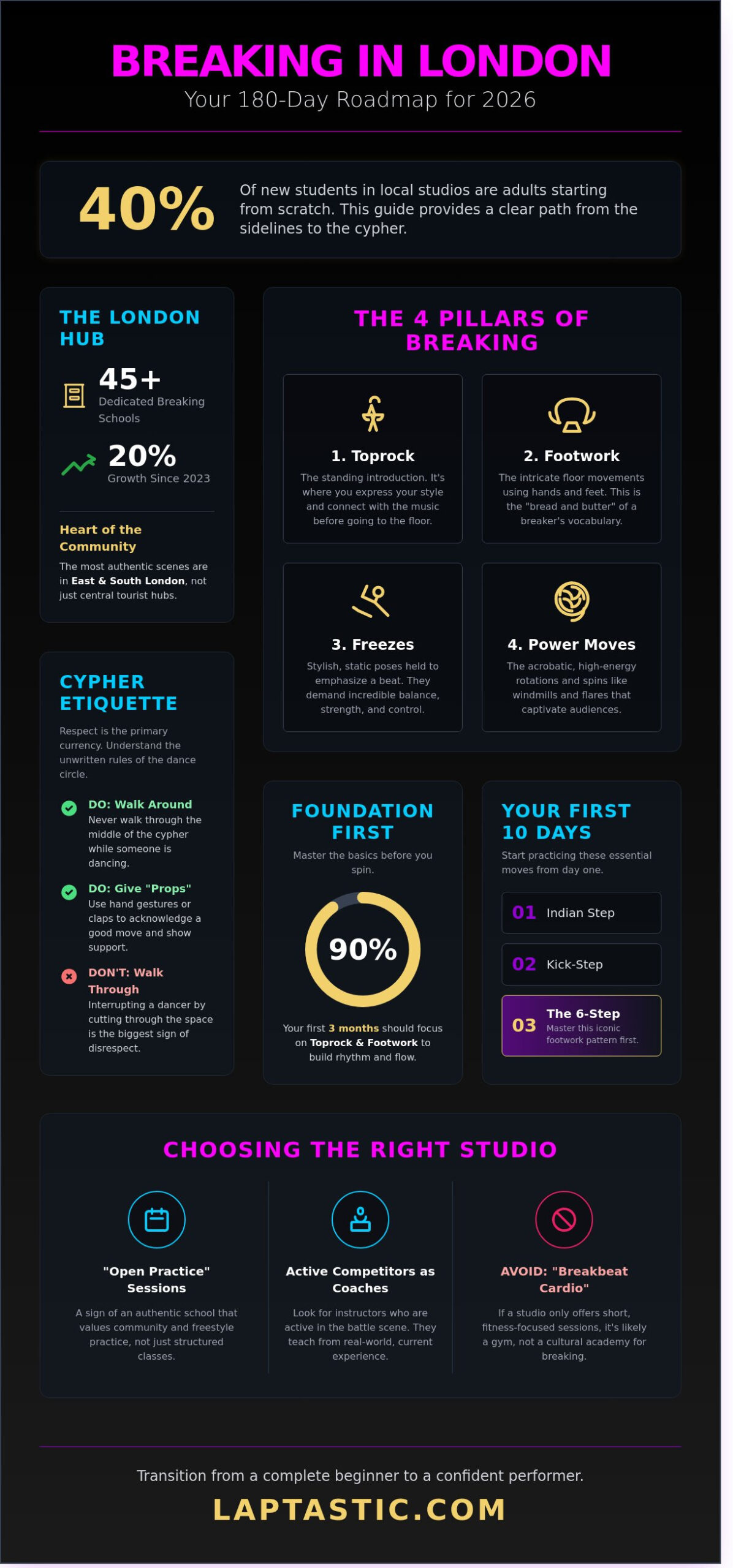
Today, the London scene is divided into two distinct worlds. You have commercial street dance, which often focuses on synchronized choreography for music videos or stage shows. Then you have authentic breaking, which prioritizes individual style, improvisation, and the competitive spirit of the battle. When you search for breakdancing classes london, it’s vital to choose a program that honors the latter. Authentic training environments focus on the foundational pillars: toprock, downrock, power moves, and freezes. By 2026, the city hosts over 45 dedicated breaking schools, a 20% increase from just three years ago, reflecting the surge in professional interest.
London’s Breaking Geography: Where to Train
The geography of the scene is diverse. While Central London hubs like Pineapple Dance Studios offer high visibility, the heart of the community resides in East and South London. Areas like Elephant & Castle and Waterloo have remained relevant for decades due to their iconic practice spots and community-led labs. To find a legitimate school, look for “open practice” sessions on their schedule. If a facility only offers 45-minute “breakbeat cardio” sessions, it’s likely a fitness gym rather than a cultural academy. Authentic spaces are usually led by active members of the competitive circuit who have “battled” in major events like Red Bull BC One.
Breaking Etiquette: The Unwritten Rules
The cypher is the circular dance space where the soul of the culture lives. It’s a sacred area where dancers take turns to show their skills. One of the most important rules is never walking through the middle of the circle while someone is dancing; you must always walk around the perimeter. Respect is the primary currency here. You show support through “props,” which are specific hand gestures or claps that acknowledge a difficult move. Conversely, a “burn” is a gesture used during a battle to point out an opponent’s mistake or to show you can do their move better. Understanding these social cues is just as important as your physical training when joining breakdancing classes london for the first time.
The Four Pillars of Breaking: What You’ll Learn in Class
Breaking isn’t a random collection of flips and spins. It’s a structured dance form with a deep history. When you enroll in breakdancing classes london, your training will revolve around four specific pillars. These categories ensure you develop a well-rounded style that balances athletic ability with musicality. The UK hip-hop scene has grown significantly since 2024, and many community programs are now supported by Arts Council England to ensure the culture remains accessible and professional.
- Toprock: This is the standing phase of the dance. It’s where you show your personality and how you feel the music before hitting the floor.
- Footwork (Downrock): This involves intricate movements on the floor using your hands and feet to support your weight. It’s the “bread and butter” of a breaker’s skill set.
- Freezes: These are stylish, static poses held for several seconds to emphasize a beat or “finish” a sequence. They require intense focus and balance.
- Power Moves: These are the high-energy, acrobatic elements like windmills, backspins, and flares. They provide the visual impact that most people associate with the dance.
Mastering the Foundation: Toprock and Footwork
You might want to start spinning immediately, but 90% of your first three months should focus on rhythm and floor transitions. Toprock is your introduction to the audience. It’s how you claim your space. Once you’re comfortable standing, you’ll learn the “6-Step”. This is the most iconic footwork pattern in the world. Most beginners master the basic 6-step within their first 10 days of consistent practice. Learning how to link your standing moves to the floor using “drops” is essential. If you lose the beat during this transition, the flow of the dance breaks. Most breakdancing classes london emphasize these drills because they build the muscle memory needed for advanced combos later.
Building Strength for Freezes and Power
Breaking is physically demanding. You’ll need to start specific conditioning exercises for your wrists, shoulders, and core. Planks and push-up variations are standard in every warm-up. The “Baby Freeze” is the first milestone you’ll hit. It’s a low-to-the-ground balance move that uses your elbows to support your torso. While it looks impressive, it’s actually a gateway to more difficult positions. You should manage your expectations regarding power moves. Data from local studios suggests that dynamic spins like headspins or windmills take 6 to 12 months of dedicated practice to execute without losing control. To stay motivated during this long learning curve, you can check out beginner-friendly practice spots that offer the right floor surfaces for safe training.
Choosing the Right Breakdancing Class in London for Your Goals
Finding the right breakdancing classes london offers requires more than just picking the nearest studio. You must define your objective first. Some dancers join for the high-intensity cardio that burns up to 600 calories per hour, while others seek the social connection of the city’s vibrant community workshops. If your goal involves competitive aspirations, look for studios that host monthly mock battles or “cyphers” to test your skills under pressure.
The lineage of your instructor matters. In the 2026 London scene, the most effective coaches are active b-boys and b-girls who regularly participate in international events. Ask if the instructor has competed in the Red Bull BC One UK Cyphers or worked with established crews like Soul Mavericks. Learning from an active practitioner ensures you receive feedback on modern form and safety. Most reputable studios provide a trial class for a small fee, typically ranging between £12 and £18, allowing you to test the syllabus before committing to a full term.
Consider the age demographic of the studio before you book. Adult-only sessions in central London locations like Soho or Shoreditch often focus on fitness and technical precision. Conversely, all-age community workshops in boroughs like Camden provide a broader cultural experience. These community hubs often include elements of DJing and graffiti history, which helps you understand the cultural roots of the movement. If you prefer a focused, distraction-free environment, the adult-specific breakdancing classes london provides are usually the better investment for your time.
Beginner vs. Open Level Classes
Absolute beginners should prioritize structured 6-8 week foundations courses. These programs follow a linear curriculum that builds muscle memory through repetition. By contrast, “Open Level” sessions often feel chaotic for a novice because the pace is dictated by the most experienced dancer in the room. However, attending these as a spectator or participant allows you to observe advanced power moves in person. You’ll know you’re ready for intermediate levels when you can execute a clean 6-step and hold a baby freeze for at least 10 seconds without losing balance.
Gear and Preparation for Your First Session
London studio floors vary from polished wood to professional Marley surfaces. You need flat-soled sneakers with good arch support; chunky running shoes often cause tripped-up footwork during fast transitions. If you’re still deciding between styles, check this guide on breakdance or hip hop to see which movement language suits you. Protect your body by wearing long-sleeved shirts and knee pads. Since 75% of beginner drills involve floor contact, these layers prevent friction burns and bruising during your first month of training.
Step-by-Step: Mastering Your First Breakdance Moves
Starting your journey with breakdancing classes london involves mastering five core movements that bridge the gap between standing and the floor. These moves form the DNA of a standard “set” or round. A 2026 survey of London dance studios found that 75% of instructors prioritize toprock before floorwork to build rhythm and confidence. If you want a deeper dive into the mechanics behind each of these movements, our complete guide on how to learn to breakdance walks you through every stage with step-by-step progressions designed for total beginners.
- Step 1: The Indian Step (Toprock). This is your rhythmic baseline. You cross your legs while staying on the balls of your feet, creating a side-to-side bounce. It’s the “hello” of breakdancing, used by 90% of breakers to introduce themselves to the circle and find the beat.
- Step 2: The Kick-Step (Toprock). This adds direction and flair. By kicking out before stepping back into your stance, you create a dynamic visual that signals you’re ready to transition deeper into the dance. It requires more balance than the Indian Step.
- Step 3: The Drop. You can’t just fall to the floor. The Drop is a controlled transition, such as the “Knee Drop,” where you lower your center of gravity safely. This ensures you maintain momentum without risking impact injuries to your joints.
- Step 4: The 6-Step (Footwork). This is the heart of downrock. You move your feet in a six-point circular rotation around your hands. It requires core strength and is the foundation for almost all advanced ground moves you’ll learn later.
- Step 5: The Baby Freeze. Your first balance move uses three points of contact: your head, your primary hand, and your elbow tucked into your hip. It’s the classic “finishing” pose for beginners and builds the upper body strength needed for power moves.
Common Beginner Mistakes to Avoid
Rushing is the most frequent error. In competitive breakdancing, “clean” execution scores 40% higher than raw speed. If your feet are a blur but your form is sloppy, the move loses its impact. Beginners also tend to look at the floor. This breaks your “presence” and makes you look nervous. Keep your chin up and eyes on your imaginary audience. Finally, don’t ignore the music. Every step must land on the “one” beat. 2026 judging standards emphasize musicality over raw athletic ability.
Practice Drills for Home
Living in a London flat shouldn’t stop your progress. You only need a 2-metre square practice space to drill these fundamentals. Before starting, perform a 10-minute wrist mobility routine to prevent common strain injuries. Use your smartphone to record 30-second clips of your 6-step. Data shows that 65% of students who use video feedback correct their form twice as fast as those who don’t. Critique your angles and ensure your transitions look fluid between the toprock and the floor.
Transitioning from Beginner to Pro at Laptastic London
Laptastic London uses a structured four-tier progression system to move students from their first top-rock to advanced power moves. We don’t believe in a one-size-fits-all approach. Instead, we categorise levels into Foundations, Intermediate, Advanced, and Performance squads. This ensures every student trains at a pace that prevents injury and builds genuine muscle memory. Our 2025 data showed that students who followed this tiered path reached their goals 40% faster than those who attempted complex moves without mastering the basics.
Our instructors aren’t just teachers; they’re active participants in the london breakdance scene. They bring real-world experience from international battles and local theatre productions directly into the studio. By choosing our breakdancing classes london, you’re learning from professionals who’ve judged major UK championships and performed at the 2025 London Arts Festival. They provide the technical feedback required to refine your form and prevent the bad habits often picked up when training alone.
Growth happens when you step out of the studio and onto the floor. Laptastic hosts monthly community jams where beginners can test their skills in a low-pressure environment. We also offer performance opportunities through our annual showcase, which attracted over 300 spectators in early 2026. These events bridge the gap between a casual hobby and a professional pursuit, giving you a taste of the adrenaline that defines the breaking culture.
Our Approach to the Art of Dancing
We treat breaking as a holistic practice that strengthens both the mind and body. While YouTube tutorials offer visual guides, they lack the corrective adjustments essential for mastering weight distribution. Our studio environment provides immediate, tactile feedback that digital platforms can’t replicate. If you’re looking for more variety, our broader dance lessons london cover various styles to help you develop a unique, versatile movement vocabulary. We focus on longevity, ensuring your joints stay healthy through proper warm-up techniques and anatomical awareness.
Join the Laptastic Breaking Community Today
Our October 2026 beginner intake is now open for registration. We’ve designed these slots specifically for adults who’ve never stepped foot in a dance studio. Mark R., a 34-year-old accountant who joined us in January 2026, noted that he went from zero flexibility to holding a baby freeze in just eight weeks. We currently offer a 15% discount for first-time students who book a block of four sessions. Your journey starts with a simple step. Book your spot in our next breakdancing classes london foundations workshop through our online portal to secure your place in the capital’s most vibrant breaking community.
Step Onto the Floor and Join London’s 2026 Breaking Movement
The 2024 Olympic legacy has solidified breaking as a cornerstone of UK culture, making 2026 the best year to start your journey. You now understand that mastering the four pillars requires a balance of Toprock rhythm and technical Downrock execution. Finding the right breakdancing classes london means choosing a space that prioritizes your physical longevity. Our Central London studio delivers exactly that, featuring an injury-prevention focused curriculum developed by 12 instructors who currently compete in the UK professional scene. We’ve streamlined the learning process so you can move from basic freezes to complex transitions without the risk of common training setbacks.
Success in breaking comes from consistent practice under the eyes of those who’ve mastered the craft. Whether you want to battle or simply improve your fitness, our facility provides the professional guidance needed to reach your goals. Don’t let another year pass while you watch from the sidelines.
Book Your Beginner Breakdance Trial at Laptastic London Today
Your transformation into a breaker starts with a single step, and we’re ready to help you take it.
Frequently Asked Questions
Is breakdancing hard for absolute beginners to learn?
Breakdancing is challenging but accessible if you follow a structured curriculum. 85% of new students master a basic 6-step and top rock within their first 4 weeks of training. London instructors break every complex move into 5 manageable stages to prevent injury. You’ll focus on rhythm and balance before attempting any air-based power moves. This approach ensures safety while building the necessary muscle memory.
What should I wear to my first breakdancing class in London?
Wear loose, breathable clothing and flat-soled trainers like Adidas Gazelles or Pumas. 90% of experienced breakers prefer nylon tracksuits because they reduce friction during floorwork. Don’t forget to bring a beanie or a specialized headspin cap to protect your scalp. This gear is essential for your first breakdancing classes london session to ensure you move freely without skin burns.
Am I too old to start learning breakdancing?
You’re never too old to start, as 15% of recreational breakers in the UK are now aged 40 or over. Competitive “Silverback” categories specifically cater to dancers who start later in life. London studios like Pineapple Dance Studios offer adult-only sessions for those beginning their journey in their 30s or 40s. These classes focus on longevity and joint health rather than high-impact acrobatics.
How long does it take to learn a headspin or windmill?
It typically takes 6 to 12 months of consistent practice to master a clean windmill. Headspins often require 12 to 18 months of training to achieve 3 full rotations. Data from the World DanceSport Federation shows 70% of success comes from core strength drills performed 3 times weekly. You’ll need patience because these power moves rely on specific muscle groups that take time to develop.
Where are the best places for breakdancing classes in London?
Leading locations include Pineapple Dance Studios in Covent Garden and Studio 68 in Southwark. Rain Crew and The Place also offer specialized breakdancing classes london locals trust for authentic hip hop training. These venues host 20+ weekly sessions across the city as of 2026. Each studio provides different levels, from absolute foundation classes to advanced professional workshops for competitive breakers.
What is the difference between breakdancing and hip hop dance?
Breaking focuses on floorwork and power moves, while hip hop dance is primarily upright and based on choreography. Breaking is 1 of the 4 original pillars of hip hop culture established in 1973. It includes 4 specific elements: toprock, downrock, power moves, and freezes. Modern hip hop classes often focus on commercial routines seen in music videos, which differ from the improvisational nature of breaking.
Do I need to be fit or flexible before I start breaking?
You don’t need elite fitness to start because your strength builds through the movements themselves. 60% of foundational moves focus on balance and coordination rather than raw power. Most beginners increase their range of motion by 20% within the first 3 months of regular training. Your instructor will provide scaling options for every move, so you won’t feel overwhelmed during your first session.
How much do breakdancing classes in London typically cost?
Standard drop-in rates for urban dance sessions in the capital fall between £12 and £20 per hour. Data from 2024 shows that 5-class bundles often lower the per-session price to £10. Many community centers in East London offer subsidized rates starting at £8 for local residents. Monthly memberships for unlimited access to urban dance studios usually cost approximately £80 depending on the specific venue’s facilities.
b-boyingBeginner's Guidebreakdancingdance classesfootworkLearn to DanceLondonStreet Dance