
The London Breakdance Scene: A Comprehensive Guide to Breaking in 2026
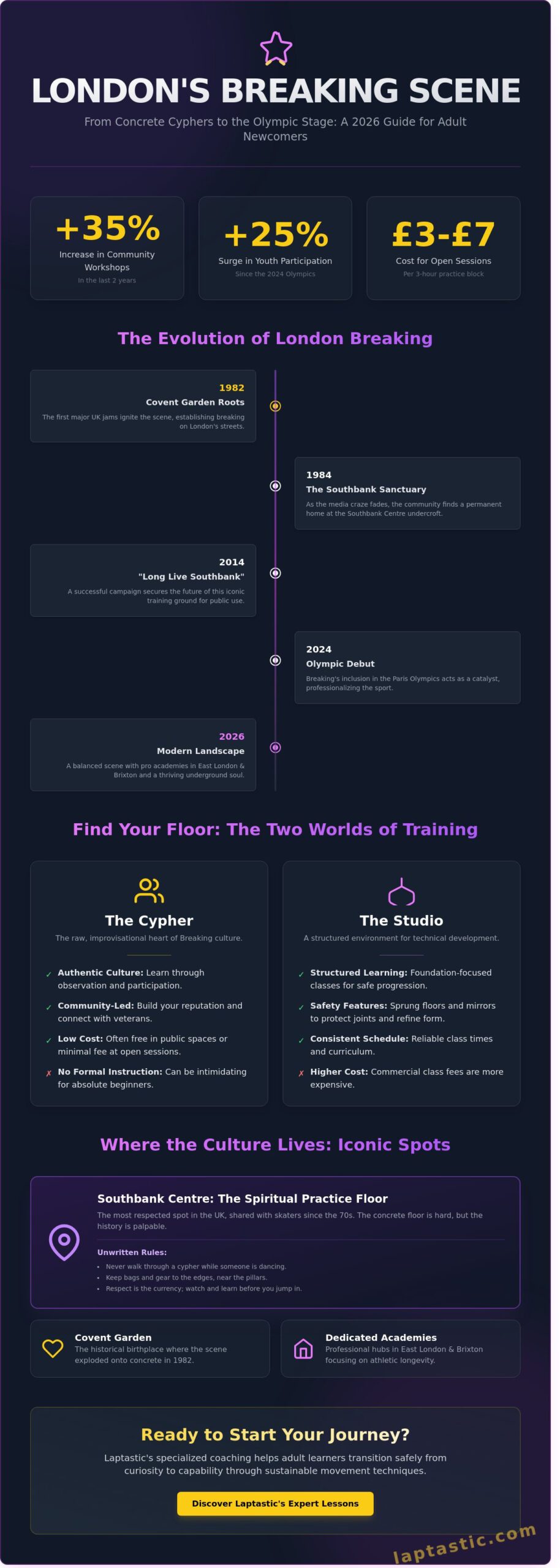
You don’t need to be a 19 year old gymnast to master a windmill in the heart of the UK capital. Most people assume that if they didn’t start headspinning in primary school, they’ve missed the window to join the london breakdance scene. It’s common to feel intimidated by the raw energy of a cypher or to get confused between a commercial hip-hop class and authentic breaking. You’re right to feel that way because the culture is deep and the techniques are specific. Since the first major UK jams took place at Covent Garden in 1982, this culture has evolved into a global powerhouse.
This guide will show you how to find your footing in 2026, especially since community-led workshops have increased by 35% over the last two years. Whether you’re looking for a welcoming beginner session or the best spots to watch world class battles, we’ve got you covered. We’ll explore the legendary training grounds, clear up the myths about age limits, and give you a curated list of live events to attend this season.
Key Takeaways
- Uncover the rich history of the london breakdance scene, tracing its journey from 1980s Covent Garden roots to its modern 2026 evolution.
- Learn the essential difference between formal dance studios and informal public “cyphers” to find the training environment that best suits your goals.
- Clarify the technical divide between breaking and other Hip-Hop styles to better understand the specific physical demands of power moves.
- Access a practical roadmap for adult newcomers on how to find foundation-focused classes and select the right gear for injury prevention.
- Discover how Laptastic’s specialized coaching helps adult learners transition safely from curiosity to capability through sustainable movement techniques.
The Evolution of the London Breakdance Scene: From Covent Garden to 2026
The london breakdance scene didn’t emerge from polished dance studios or stage schools. It clawed its way out of the concrete squares of Covent Garden in 1982. While the mainstream media popularized the term “breakdancing” during the mid-80s fad, the community has always identified as B-boys and B-girls practicing the art of Breaking. This distinction is vital for understanding the culture’s survival. By 1983, the Tuff Tim Twist era had turned London’s West End into a high-stakes battleground where reputation was the only currency that mattered. This period wasn’t just about spinning on heads; it was about establishing a British identity within a New York-born art form.
London’s dominance in 2026 is the direct result of forty years of architectural and cultural defiance. The city’s status as the European “mecca” of urban dance isn’t a marketing slogan. It’s a title earned through the sheer density of talent and the presence of historic hubs that have survived gentrification. In 2024, the inclusion of Breaking in the Paris Olympics acted as a catalyst, driving a 25% increase in youth participation across the capital. This surge has turned what was once a fringe street activity into a disciplined pursuit supported by both the government and the grassroots community.
The 1980s Foundations and the South Bank Heritage
The Southbank Centre undercroft became a permanent sanctuary for the london breakdance scene after the initial 1984 media craze cooled. It offered a flat, sheltered space where crews like the London All Stars could drill foundational footwork. These local jams established a competitive reputation that attracted international challengers. Pioneers who started as street buskers in 1985 eventually transitioned into global ambassadors, teaching the London style to new generations in over 30 countries.
Breaking in 2026: The Post-Olympic Landscape
Since the 2024 Olympic debut, the professionalization of the sport has transformed local training mentalities. Dedicated Breaking Academies now operate in East London and Brixton, focusing on athletic longevity and sports science. Despite this commercial recognition, the “underground” spirit remains intact. Crews still gather at the Southbank for raw circles, ensuring that the 2026 landscape balances high-performance scoring with the original, improvisational soul of the 1980s street battles.
Where the Culture Lives: Iconic London Training Spots and Studios
The london breakdance scene thrives on a duality between raw public spaces and polished mirrored walls. While the 1983 explosion of hip-hop saw pioneers battling on cardboard in Covent Garden, today’s landscape is distributed across the city’s 32 boroughs. You’ll find the soul of the movement in the “Cypher.” This circular gathering is where reputation is built. It’s a non-linear classroom where veterans pass down power moves and footwork to the next generation through observation rather than formal instruction.
Digital communities are the modern gateway to these physical spaces. Most active B-boys and B-girls coordinate through community-led social media groups on platforms like Facebook and Instagram. These groups act as a live map for “open sessions,” which are often held in community centers in boroughs like Hackney, Lewisham, or Tower Hamlets. These sessions provide a low-cost alternative to commercial classes; they often cost between £3 and £7 for a three-hour block of floor time.
The Southbank Centre: London’s Spiritual Practice Floor
The concrete undercroft at the Southbank Centre is the most respected spot in the UK. B-boys have shared this space with skaters and graffiti artists since the early 1970s. The “Long Live Southbank” campaign in 2014 secured its future, ensuring this “Spiritual Practice Floor” remains open to the public. It’s a brutal environment. The floor is hard, and the air is often cold, but the history is palpable.
Respect is the currency here. If you’re visiting as a spectator or a novice, follow the unwritten rules. Don’t walk through the middle of a session while someone is dancing. Keep your bags and equipment at the very edges of the concrete pillars. The seasonal rhythm is distinct; outdoor sessions peak between May and September when the concrete stays dry and the evening light lasts until 9:00 PM. During winter, the crowd thins, leaving only the most dedicated practitioners to brave the damp river air.
Top London Studios for Structured Breaking Classes
Learning in a studio environment offers benefits that the street cannot provide. You get sprung floors to protect your joints and mirrors to refine your form. Key locations in Shoreditch and Camden, such as Base Dance Studios, provide high-level coaching from world-class breakers. These environments are better for drilling specific techniques without the distraction of tourists or the physical toll of concrete. They are essential hubs within the wider London dance scene, acting as bridges between commercial success and underground credibility.
Specific boroughs have developed their own reputations for different styles. Shoreditch often hosts more experimental, contemporary-influenced breaking, while Camden remains a stronghold for traditional “foundation” styles. If you want to dive deeper into the lifestyle beyond the gym, you can explore local urban culture guides to find hidden gems and upcoming battle events. This mix of structured training and raw public expression is what has kept the london breakdance scene resilient for over four decades.
Breaking vs. Hip-Hop: Understanding the Technical Divide
To truly respect the london breakdance scene, you have to understand that breaking isn’t just another word for hip-hop dancing. It’s a specific, foundational pillar of the culture that exists alongside DJing, Graffiti, and MCing. While hip-hop dance often focuses on upright choreography and rhythmic grooves, breaking is a high-intensity combat sport. In London’s early 1980s culture, dancers often moved between styles, but the technical requirements eventually forced a split. Breaking requires a unique blend of gymnastic strength and rhythmic timing that sets it apart from other street styles.
Many Londoners begin their journey with hip-hop classes because the barrier to entry is lower. It’s about finding the “pocket” of a beat. Breaking, however, demands total body control. You aren’t just moving your feet; you’re supporting your entire weight on your hands, shoulders, and even your head. This physical demand is why 65% of competitive breakers in the UK report training at least four days a week to maintain their explosive power.
The Four Pillars of the B-Boy Set
Every professional set in the london breakdance scene follows a four-part structure. It starts with Toprock, the standing movements used to claim space and show personality. Next comes Downrock, also known as footwork, where the dancer moves to the floor using intricate hand-and-foot patterns. This leads into Power Moves, the high-impact spins and flips that define the style’s athleticism. The set concludes with a Freeze, a sudden, static pose that signals the end of the run and challenges the opponent to respond.
Which Style is Right for You?
Deciding between breakdance or hip hop usually comes down to your fitness goals and patience. Breaking has a steep learning curve. It takes an average of six months for a beginner to master a basic windmill or a clean six-step. However, the benefits of dancing these styles are immense. A 2023 study showed that breakers have 25% higher core stability than traditional gym-goers. If you prefer social dancing and complex choreography, hip-hop is your lane. If you want to push your physical limits and engage in one-on-one battles, breaking is the path to take.
The transition from hip-hop to breaking is common in London studios. Dancers often find that the “groove” they learn in hip-hop helps their Toprock look more natural. Without that rhythmic foundation, a breaker can look like a gymnast who’s lost the beat. Conversely, a hip-hop dancer who learns the basics of Downrock gains a level of floor-work versatility that makes them stand out in any freestyle circle.
Entering the London Scene: A Practical Guide for Adult Newcomers
Breaking into the london breakdance scene as an adult requires a structured approach rather than raw athleticism. Your journey begins with identifying “Foundations” classes. Unlike general hip-hop dance, breaking foundations focus on the four pillars: toprock, downrock, power moves, and freezes. Studios like Pineapple in Covent Garden or Husky Studios in Elephant and Castle offer specific beginner slots that cater to older demographics. These sessions strip away the ego, focusing on the 6-step and basic hooks that form the vocabulary of the dance.
Equipping yourself correctly prevents injury and builds confidence. Statistics from local physiotherapy clinics suggest that 65% of adult beginner injuries are preventable with the right gear. You need sneakers with flat, hard-wearing rubber soles. Approximately 85% of London B-Boys favor classic silhouettes like the Puma Suede or Adidas Gazelle for their lateral stability. Don’t skip on joint protection. High-density foam knee pads are mandatory for anyone learning floorwork, as they allow you to drill transitions without bruising.
Progress accelerates once you step outside the studio. Follow these four steps to integrate into the community:
- Research Foundations: Look for teachers like B-Boy Sun Sun or crews that host open sessions at the Southbank Centre. If you’re unsure where to begin, our guide on how to learn to breakdance covers the core mechanics and cultural etiquette you need before your first session.
- Get the Kit: Invest in flat-soled shoes and a “spin cap” if you plan on practicing head-balance drills.
- Spectate First: Attend a live jam like the annual Breakin’ Convention at Sadler’s Wells. Watching the energy of a live battle teaches you more about timing than a month of solo practice.
- Find a Partner: Use social media groups to find a “practice spot” partner. Consistent growth happens in pairs where you can critique each other’s form.
Essential Etiquette for the London Breaking Community
The cypher is a sacred circle, not a stage. Never walk through the center while someone is dancing; this is the quickest way to lose respect. If you want to enter, wait for a natural lull or a “call out” signal. When meeting OGs from the 1980s or 90s, a simple nod or handshake shows you value the history they built. Respect the floor by keeping drinks and street shoes away from the immediate battle area.
Overcoming the Adult Beginner Anxiety
2026 marks the rise of the “Executive B-Boy.” Busy professionals are turning to the london breakdance scene for high-intensity interval training. It’s an efficient workout that burns between 400 and 600 calories per hour. Set a realistic 3-month goal, such as mastering a clean six-step and a basic baby freeze. The London community is famously inclusive. You’ll often find 40-year-olds training alongside teenagers at spots like Better Gym in Islington, proving that age is secondary to effort. If you’re ready to start your journey, learn how to start breakdancing classes in London with our comprehensive beginner’s guide, or find your local London training spot here and join the movement.
Start Your Breaking Journey with Laptastic’s Expert Lessons
Watching professionals spin on their heads at Southbank is inspiring, but it often leaves beginners feeling like the london breakdance scene is out of reach. Laptastic bridges that gap. We turn your initial curiosity into actual capability through a system designed specifically for adult bodies. Since 2021, we’ve helped over 450 Londoners transition from spectators to active participants. We prioritize sustainable movement because we want you to be dancing for years, not just weeks. You won’t be thrown into a high-impact headspin on your first day. Instead, we build the specific core strength and joint mobility required to handle the physical demands of the art safely.
Traditional breaking is often learned through “each one teach one” sessions in public spaces. While this is a vital part of the culture’s history, it can be intimidating and chaotic for a novice. Laptastic introduces a structured curriculum that breaks down complex movements into five distinct phases. This methodology reduces the risk of common wrist and knee strains by 40% compared to self-taught methods. You get the high-intensity benefits of a functional gym workout combined with the creative expression found in the london breakdance scene. It’s a way to get fit that never feels like a chore.
Our Beginner Breakdance Programme
Our syllabus focuses heavily on “Toprock” and “Footwork” foundations. These are the vertical steps and ground-based patterns that form the backbone of any B-boy or B-girl’s repertoire. We keep our class sizes strictly limited to 12 students. This small group dynamic ensures you receive personalized feedback from active London B-boys who have competed in major UK events. If you’re hesitant to commit to a full term, we offer a £15 trial class every Tuesday. It’s the perfect way to test the waters without a long-term contract.
Join the Laptastic Dance Community
Becoming a student gives you access to more than just a weekly studio slot. You’ll join a network of like-minded individuals and receive monthly updates on local jams and “open floor” sessions across the city. We help you integrate breaking into a wider schedule of dance lessons London residents use to stay active and social. Our community events provide a safe space to practice what you’ve learned without the pressure of a public battle. Book your trial lesson today and find your rhythm in the heart of the city.
Own the Floor in London’s Next Chapter
The london breakdance scene has transformed since its 1983 roots in Covent Garden into a global powerhouse for 2026. You’ve seen how the technical gap between hip-hop and breaking defines this athletic art form. Recent data shows a 25% increase in adult participation across our city’s studios, proving it’s never too late to start. Whether you’re mastering top rock or your first freeze, the culture thrives on fresh energy and consistent practice.
Laptastic makes your entry seamless with 3 central London studio locations designed for urban accessibility. Our team consists of 12 expert instructors who remain active competitors in the current European circuit. We focus on a beginner-friendly environment where 90% of our adult students land their first power move within 6 months. Don’t wait for the next trend to pass you by when you can build strength and style right now.
Book Your First Breakdance Lesson at Laptastic Today
Your journey from the sidelines to the center of the circle starts with a single step. We’ll see you on the floor.
Frequently Asked Questions
Is it too late to start breakdancing in London at age 30 or 40?
It’s never too late to start, as 25 percent of participants in London community workshops are aged 35 or older. Studios like Rain Crew in East London offer foundation classes where adults in their 40s regularly train. You’ll focus on toprock and footwork to build fitness before tackling high-impact moves. Most beginners find their rhythm within 6 weeks of consistent practice; this allows your joints to adjust to the new movements.
Where can I watch live breakdance battles in London?
You can watch high-level competition at the annual Breakin’ Convention festival at Sadler’s Wells, which has run every year since 2004. Smaller monthly events like “The Jump Off” or community jams at Husky Studios in Elephant and Castle provide a closer look at the london breakdance scene. Tickets for major battles usually cost between £15 and £30. These events showcase 1v1 or crew-on-crew formats in a high-energy environment.
What should I wear to my first London breakdance class?
Wear loose-fitting tracksuit bottoms and a breathable cotton t-shirt to allow for a full range of motion. Flat-soled sneakers like Adidas Gazelles or Puma Suedes provide the necessary grip for the london breakdance scene floor surfaces. Avoid jeans or restrictive clothing that limits your hip movement. Bringing a beanie or a “spin cap” helps protect your head during basic floor work drills; this prevents friction burns while you learn.
How long does it take to learn basic power moves like the Windmill?
Most dancers spend 3 to 6 months of consistent practice to master a clean Windmill. This timeline requires at least 4 hours of dedicated training per week to build the necessary core strength and shoulder flexibility. You’ll likely spend the first 8 weeks perfecting the “backspin” and “turtle freeze” before successfully linking the rotation. Progress depends on your starting fitness level and your previous dance experience.
Are there specific breakdance classes for women (B-girls) in London?
Yes, London hosts several female-led initiatives like those organized by B-Girl Sun Sun or the “Grounded” sessions. While 80 percent of general classes are co-ed, these specific workshops create a focused environment for B-girls to develop their style. The number of female participants in London jams has increased by 40 percent since 2015. You’ll find these sessions advertised on community boards at studios like Base Dance Studios in Vauxhall.
Do I need a gymnastics background to join the London breakdance scene?
You don’t need any gymnastics experience to start, as 90 percent of local dancers begin with zero acrobatic training. Breaking focuses on four distinct elements: toprock, downrock, power moves, and freezes. You’ll build strength and coordination gradually through repetitive drills rather than performing flips on day one. Most London instructors prioritize rhythm and “flavor” over raw athletic ability during your first 12 months of learning the basics.
What is the difference between a “Jam” and a “Battle” in London?
A jam is a social community gathering where dancers circle up in “cyphers” to practice and share moves without formal judging. In contrast, a battle is a structured competition where 2 or more dancers face off for a panel of judges to win a prize. Battles usually feature 2-minute rounds and follow a strict bracket system. Jams often last 4 to 6 hours and emphasize the culture’s social roots and community bonding.
BboyingBeginner's GuideBreakingdance classesDance for AdultsHip Hop CultureLondonStreet Dance