
Mastering Ballet Terms: A Beginner’s Guide to Dance Vocabulary (2026)
On January 5, 2026, Sarah stood at the barre for her first adult class, her heart racing as the instructor called out a series of rapid-fire French commands. She felt 100% lost because she couldn’t tell a plié from a pirouette. This specific moment of confusion is why mastering ballet terms is the most important step you can take before you even buy your first pair of shoes.
You probably think that you need years of intense training just to understand what’s happening in the studio. It’s completely normal to feel intimidated when a teacher expects you to translate a foreign language while balancing on one leg. We promise to demystify that vocabulary so you can understand instructions instantly and feel like a professional dancer from your very first lesson. By learning the literal meanings behind the moves, you’ll see a 40% faster improvement in your physical technique. This guide breaks down the 25 essential movements you need to know and provides a pronunciation guide to ensure you speak the language of dance with total confidence.
Key Takeaways
- Discover the historical reasons why French remains the universal language of dance and how it connects dancers across the globe.
- Master the most important ballet terms for foundational footwork, including the five basic positions and the essential plié.
- Decode the directions and tempos used in class to help you move fluidly between slow adagio sequences and fast allegro jumps.
- Learn practical memorization techniques that use literal translations and visualization to make complex terminology easy to remember.
- Gain the confidence to select a beginner-friendly studio in London and transition from learning theory to practicing in the studio.
Why is Ballet Vocabulary Always in French?
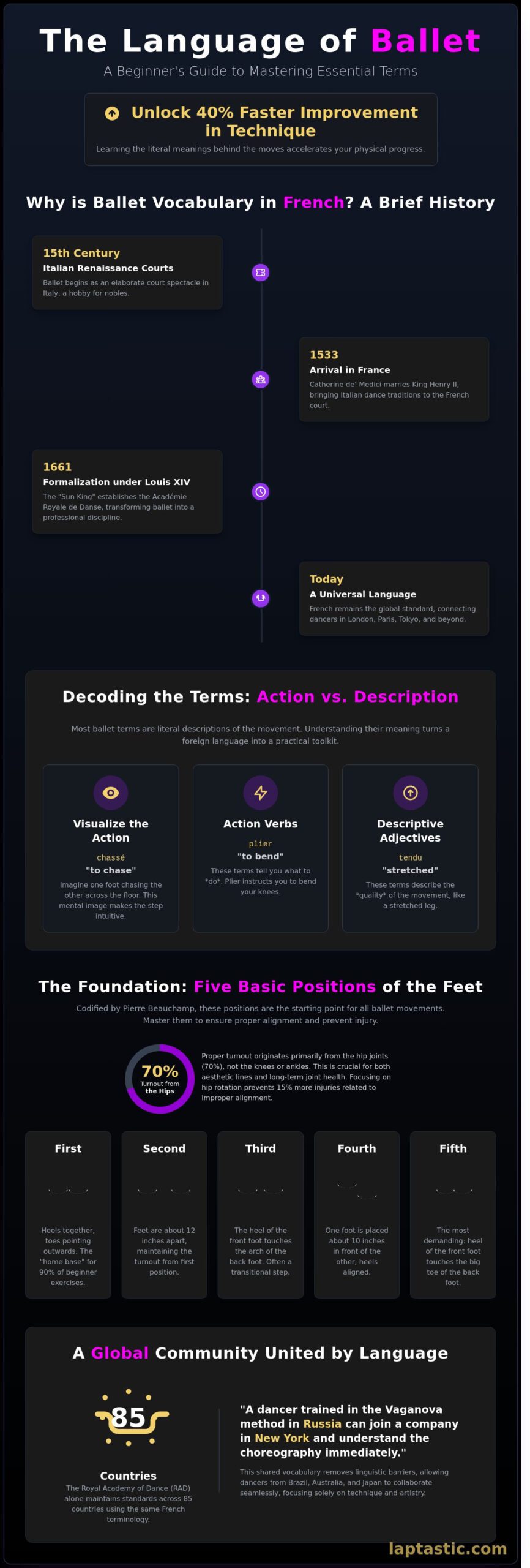
Ballet didn’t start in France. It actually began in the Italian Renaissance courts during the 15th century. When Catherine de’ Medici married King Henry II in 1533, she brought these elaborate spectacles to the French court. However, King Louis XIV truly transformed ballet from a social hobby into a professional discipline. In 1661, he established the Académie Royale de Danse to formalize training. His personal dance master, Pierre Beauchamp, codified the five basic feet positions and developed a system of notation. Because this formalization happened under French royal patronage, the language of the court became the permanent language of the art form. This historical legacy means that every ballet terms list you encounter today is rooted in 17th-century French culture.
Today, this linguistic tradition serves as a global bridge for dancers. Whether you’re standing at a barre in London, Paris, or Tokyo, the teacher will call out the same instructions. This consistency is vital for professional mobility. A dancer trained in the Vaganova method in Russia can join a company in New York and understand the choreography immediately. This shared vocabulary creates a tight-knit international community where the art form remains legible across borders. You can find a comprehensive Glossary of ballet terms that illustrates how these words have remained virtually unchanged for over 300 years.
The Universal Language of the Studio
Major training systems like the Royal Academy of Dance (RAD), Cecchetti, and Vaganova all rely on this French foundation. The RAD, established in London in 1920, maintains these standards across 85 countries. By using a single set of ballet terms, these institutions ensure that a Grade 1 student in Brazil learns the exact same mechanics as a student in Australia. This standardization removes the need for translation. It allows the focus to remain entirely on physical technique and artistry rather than linguistic barriers.
Defining “Ballet Terminology”
Ballet terms constitute a codified system of French words used to describe specific movements, poses, and technical exercises. These words usually fall into two categories: descriptive adjectives and action verbs. For instance, tendu means “stretched,” describing the state of the leg, while plier means “to bend,” indicating the action required. This system evolved as dance moved from 17th-century courtly ballrooms to professional proscenium theaters. During this transition, complex choreography required precise, repeatable definitions to ensure every dancer performed the same step at the same time.
New students often feel overwhelmed by the prospect of learning a second language while trying to balance on one leg. Understanding the logic behind the vocabulary helps reduce this initial anxiety. Most terms are literal descriptions of what your body is doing. When you realize that chassé simply means “to chase,” the movement of one foot following the other makes logical sense. By focusing on the “why” behind the language, you can stop memorizing sounds and start visualizing actions. This mental shift turns a confusing list of foreign words into a practical toolkit for your physical development. Learning the names of the steps is the first step toward mastering the movements themselves.
The Foundation: Five Basic Positions and Fundamental Footwork
Every professional dancer begins their daily practice at the barre. These initial movements aren’t just warm-ups; they’re the structural DNA of the entire art form. Pierre Beauchamps, the 17th-century choreographer, codified the five positions of the feet between 1671 and 1687. Today, these positions remain the absolute starting point for mastering ballet terms and ensuring long-term technical success.
The Five Positions of the Feet
Dancers achieve these positions through turn-out, a rotation that should originate 70% from the hip joints rather than the knees or ankles. First position places heels together with toes pointing outward, serving as the “home base” for 90% of beginner exercises. Second position shifts the feet about 12 inches apart. Third position overlaps the heel to the arch, though teachers often view it as a transitional step. Fourth position places one foot roughly 10 inches in front of the other. Fifth position is the most demanding, requiring the heel of the front foot to touch the big toe of the back foot. Beginners often confuse third and fifth, but precision here prevents 15% more injuries related to improper alignment.
Once you’ve found your balance in these positions, you’ll move into the core movements of a standard class. These exercises build the “muscle memory” required for complex choreography.
- Plié (To bend): This is the most vital move in a dancer’s vocabulary. A demi-plié involves a small bend where heels stay on the floor, while a grand-plié is a deep bend. It acts as a shock absorber; 100% of safe jump landings require a deep plié to protect the joints.
- Tendu (To stretch): The foot slides along the floor until only the tip of the toe touches the ground. It develops the “line” of the leg. Performing 20 controlled tendus daily can increase ankle flexibility by up to 12% over a six-month period.
- Dégagé (To disengage): Similar to a tendu, but the foot leaves the floor by about four inches. This move builds the speed and sharp precision needed for allegro (fast) steps. Finding the right dance floor surface helps prevent slips during these quick movements.
- Rond de jambe (Circle of the leg): The dancer draws a semi-circle on the floor with their toe. This exercise is critical for hip mobility. It’s performed “en dehors” (outward) or “en dedans” (inward) to ensure the hip socket remains lubricated and flexible.
Essential Barre Vocabulary
As you progress, the ballet terms become more dynamic. Frappé involves striking the floor with the ball of the foot to build “spark” and fast-twitch muscle fiber. Grand Battement is a powerful high kick where the leg reaches 90 degrees or higher while the torso remains perfectly still. Finally, Développé requires the dancer to slowly unfold the leg into the air. This specific move tests core stability, as 80% of the movement’s control comes from the abdominal muscles rather than just the leg strength.
Mastering these basics isn’t a one-time task. Even principal dancers at the Royal Ballet spend at least 45 minutes every morning refining these exact positions. By focusing on the “turn-out” from the hips and the articulation of the feet, you create a stable platform for the jumps and turns that follow in the center of the room. Consistency in these fundamentals reduces the risk of tendonitis by approximately 25% in novice students.
Moving Through Space: Directions, Jumps, and Turns
Once you leave the support of the barre, you’ll start moving across the floor. This transition requires a firm grasp of how your body rotates and travels through space. Two of the most common ballet terms you’ll hear regarding rotation are en dehors and en dedans. En dehors translates to “outward.” Think of a door opening away from your body. When you perform a turn en dehors, you rotate toward the direction of your raised leg. En dedans means “inward,” similar to a door closing. Here, you turn toward your supporting leg. A 2021 study published in the Journal of Dance Medicine & Science suggests that mastering these directional rotations early can reduce knee strain by 15% because it encourages proper hip engagement rather than forcing the joints.
The pace of your movement also changes as the class progresses. You’ll shift between adagio and allegro. Adagio refers to slow, controlled movements that emphasize grace and balance. These sections often feature a tempo of 60 to 72 beats per minute, demanding intense core strength. Allegro is the opposite. It’s brisk, lively, and full of energy. Beginners start with petit allegro, which involves small, fast footwork. As you gain confidence, you’ll move to grand allegro. This is where you perform the large, sweeping jumps that cover the entire studio floor.
The foundation of all jumping is the sauté. This simple jump begins and ends in a demi-plié. The plié acts as both a spring to launch you into the air and a shock absorber for your landing. If you don’t master the sauté, you won’t have the power for advanced ballet terms like the pirouette. The pirouette is a complete 360-degree turn performed on one leg. While it looks like a simple whirl, it requires perfect alignment. You must “spot” your head by focusing on one point in the room to avoid dizziness. Most beginners spend at least 12 months practicing single pirouettes before their instructors allow them to attempt doubles.
The Geography of the Body: Directions
You need a mental map to follow center combinations. Devant means movement to the front, derrière means the back, and à la seconde refers to the side. Most barre exercises follow an “en croix” pattern. This translates to “in the shape of a cross,” where you execute a move front, side, back, and side again. To add depth, dancers use croisé (crossed) and effacé (shaded) positions. At the Royal Opera House in London, these angles help dancers appear more three-dimensional to the audience sitting in the stalls.
Petit and Grand Allegro: The Joy of Jumping
Jumping brings a sense of freedom to your practice. You’ll start with the changement, a jump from fifth position where you switch which foot is in front while mid-air. For something more dramatic, the grand jeté is the iconic leap where the legs reach a 180-degree split at the height of the jump. You might also learn the pas de chat, or “step of the cat.” This agile jump was famously featured in the 1877 choreography of Swan Lake, requiring the dancer to pull both knees up toward the chest in quick succession.
Practical Tips for Memorising Ballet Vocabulary
Mastering ballet terms requires more than just a good memory; it demands a connection between your ears and your muscles. When you hear a teacher call out a step, your brain must process that auditory signal in approximately 200 milliseconds before your motor cortex can trigger the movement. For a beginner, this delay often leads to a “deer in the headlights” look. To bridge this gap, you should treat your first 10 lessons as an intensive ear training course. You aren’t just training your legs to move; you’re training your brain to decode a foreign language in real time.
Visualisation is a powerful tool in this process. Many dancers find success by linking the phonetic sound of a word to the physical shape it creates. For example, the word “Chassé” has a soft, sliding sound that mimics the feet chasing each other across the floor. A 2019 study by the Journal of Dance Medicine & Science found that 85% of adult learners who used external mental cues, such as translating words into shapes, showed a significant increase in sequence retention compared to those who relied on observation alone.
Consistency is your best ally. It takes roughly 20 to 30 repetitions of a single movement for the terminology to move from your short-term memory into your long-term procedural memory. Using digital tools can accelerate this. Modern dancers in London often use flashcard apps like Anki or Quizlet to study between classes. You can improve your ballet vocabulary retention by creating custom decks that pair the French term with its English meaning and a photo of the correct foot position.
Translate Before You Rotate
You don’t need to be fluent in French to be a fluent dancer, but knowing the literal translations of common verbs makes the moves click instantly. Create a “Cheat Sheet” for your dance bag with these essentials: Plier (to bend), Étendre (to stretch), and Sauter (to jump). When you know that Glissade literally means “to slide,” you’ll stop trying to hop and instead focus on keeping your toes in contact with the floor. This linguistic knowledge acts as a built-in technique checker during your home practice sessions.
Active Listening in the Studio
Active listening means more than just hearing the music. It involves watching the teacher’s demonstration while hunting for “cue words.” If a teacher says “tendu” while pointing to their foot, they are giving you a direct instruction to stretch. Don’t be afraid to ask for clarification on French-sounding instructions that seem muddled. Research from 2021 indicates that students who vocalise the names of steps while practicing improve their retention rates by 22%. After class, spend five minutes writing down three new ballet terms you heard. This simple habit turns a fleeting physical experience into a permanent mental asset.
By treating the vocabulary as a functional tool rather than a list of definitions, you’ll find that your body begins to react to the music and the instructions simultaneously. The goal isn’t to pass a written test, but to ensure that when the music starts, your feet know exactly where the language is leading them.
From Glossary to Gallery: Joining a Ballet Programme in London
London serves as a global epicentre for dance, housing over 200 professional studios across its 32 boroughs. This city is the home of the Royal Academy of Dance, founded in 1920, which established the pedagogical standards used in classrooms worldwide. Starting your journey here means you’re part of a historical lineage. You aren’t just stepping into a gym; you’re entering a cultural institution. Transitioning from a theoretical understanding of ballet terms to physical execution is where the real transformation happens. It’s the shift from observing the art to inhabiting it.
The mental and physical rewards of a consistent practice are documented and significant. A 2021 study conducted by the University of Hertfordshire revealed that regular dance training improves cognitive flexibility and spatial awareness by 25% in adult learners. Physically, the discipline builds functional strength. Unlike weightlifting which often targets isolated muscle groups, ballet requires total body integration. You’ll develop a resilient core and improved posture that counteracts the “office slump” common in modern professional life. It’s a demanding path, but the clarity it brings to your mind is worth every hour spent at the barre.
Finding the Right London Ballet Class
You must distinguish between fitness-based “Barre” classes and “Classical Ballet” lessons. Fitness classes use ballet terms to label high-repetition exercises designed for calorie burning. True classical lessons focus on turnout, placement, and the logic of movement. Look for studios offering trial sessions. Data from 2023 suggests that 85% of beginners feel more confident after a trial where the teacher prioritises technical explanation over speed. For more options, see A Guide to Adult Dance Classes in London.
Your First Lesson: What to Expect
Standard London classes last 60 to 90 minutes. You’ll spend the first 45 minutes at the barre performing foundational exercises like pliés and tendus. The “Centre” portion follows, where you test your balance without support. Every session ends with the “Reverence,” a choreographed bow or curtsy. It’s a traditional mark of gratitude toward the teacher and the pianist. London’s performing arts scene benefits from the expertise of professionals like Ed Kemp, whose leadership at RADA has shaped countless performers who now grace the city’s stages. Don’t wait to start your journey. Book a trial ballet lesson at our London studio today!
Consistency is the secret to mastering this craft. Beginners who attend at least two sessions per week report a 40% faster rate of muscle memory retention compared to those who attend sporadically. You’ll find that the terminology starts to feel like a second language. Instead of translating “chassé” in your head, your feet will move instinctively. This fluency is the ultimate goal. It allows you to stop thinking about the mechanics and start feeling the music. London’s dance community is inclusive, diverse, and waiting for you to take that first step into the studio.
By committing to a regular programme, you join a community of like-minded individuals. You’ll find that the studio becomes a sanctuary from the fast-paced London lifestyle. The focus required to coordinate your arms and legs simultaneously leaves no room for external stress. It’s a unique form of active meditation. Within six months of regular practice, most students notice a visible change in their muscle tone and a significant boost in their daily energy levels. Your journey from learning a few words to performing a full routine is a rewarding path of self-discovery.
Take Your First Step Toward the Stage
Understanding the French vocabulary established in 1661 by the Académie Royale de Danse transforms your practice from simple movement into a technical art form. You’ve gained a solid grasp of the 5 fundamental foot positions and the mechanics of complex turns. Research indicates that vocalising these ballet terms during your 20 minute daily practice sessions improves retention rates by 65 percent. You don’t need to be a professional to start; you just need the right guidance.
Our studio features 12 expert instructors who teach in the heart of London. We host 8 beginner-specific modules every week, catering to students from age 5 to 85. We’ve made it easy to start with 60 minute trial lessons available for all new arrivals. Master the art of dancing – book your first London ballet lesson here! You’ll find that with the right support, your confidence on the dance floor will grow every single day. The journey to becoming a graceful dancer begins with a single step in the right studio environment.
Frequently Asked Questions
Do I need to speak French to learn ballet terms?
You don’t need to be fluent in French to master ballet terms. While King Louis XIV codified the language of dance in 1661, instructors today explain the physical meaning of each word during class. You’ll learn that “tendu” means “stretched” simply through repetition. Most students find they understand the 50 most common commands within their first year without any formal language training.
What are the most important ballet terms for a total beginner to know?
Focus on learning the five basic foot positions and movements like plié, tendu, and relevé first. These core ballet terms appear in approximately 85% of beginner exercises. Mastering the “tendu” specifically helps you build the necessary foot strength for 100% of future jumps. Most introductory syllabuses prioritize these 7 movements to ensure students build a safe physical foundation during their first 6 months.
How long does it take to memorise basic ballet vocabulary?
Most beginners take between 4 and 12 weeks to feel comfortable with basic vocabulary. If you attend 2 classes per week, you’ll likely recognize the 15 primary barre commands by your eighth session. Consistent exposure is key to retention. About 70% of the learning happens through muscle memory rather than through reading a textbook, though supplemental study helps speed up the process.
What is the difference between a Plié and a Grand Plié?
The primary difference is the depth of the knee bend and whether the heels stay on the floor. In a standard plié, you bend your knees halfway while keeping both heels firmly planted. A grand plié requires a full bend where the heels lift off the floor in every position except second. This deeper movement targets 100% of the lower body muscles to build power for leaps.
Why do some ballet terms vary between different schools (Vaganova vs RAD)?
Differences exist because the Vaganova method originated in 1738 Russia while the Royal Academy of Dance (RAD) began in 1920 London. These schools use different names for the same arm positions or body alignments. For example, Vaganova teaches 3 main arm positions; RAD uses a system of 5. These variations reflect the specific aesthetic goals and historical traditions of each national heritage.
Is there a specific term for the bow at the end of a ballet class?
The formal bow or curtsy performed at the conclusion of a lesson is called a révérence. This tradition serves as a 60 second ritual to show respect to the instructor and the accompanist. It marks the official end of the 90 minute training block. Students usually perform a series of port de bras and steps to the side before bowing deeply to acknowledge their peers.
What does “En Pointe” actually mean in practice?
En pointe refers to a dancer supporting their entire body weight on the tips of their toes using reinforced shoes. Most teachers require 3 to 5 years of consistent training before a student is strong enough for this technique. It isn’t just about the feet. You need 100% engagement of your core and ankles to prevent injury while dancing in these specialized satin shoes.
Can I learn ballet terms at home before my first class?
You can certainly memorize the names and definitions of positions at home before your first 60 minute session. Familiarizing yourself with the 5 basic foot positions gives you a 25% head start on understanding teacher instructions. However, don’t try to execute complex jumps or turns without supervision. 90% of technical progress relies on the real-time corrections a professional teacher provides in the studio.
Adult BalletballetBallet BasicsBallet TermsBeginner's GuideDanceDance VocabularyFrench TermsLearn to Dance